

Medical coding is not just a back-office function. It is the bridge between clinical work and reimbursement. When that bridge has cracks, claims get denied, audits get triggered, and revenue quietly walks out the door. The frustrating part is that most of these errors are preventable.
After years of working in revenue cycle and coding compliance, the same patterns keep showing up. The errors are rarely random. They cluster around specific code sets, specific workflows, and specific habits that practices develop over time without realizing the downstream consequences.
This article breaks down where those errors live, why they happen, and what you can actually do about them.
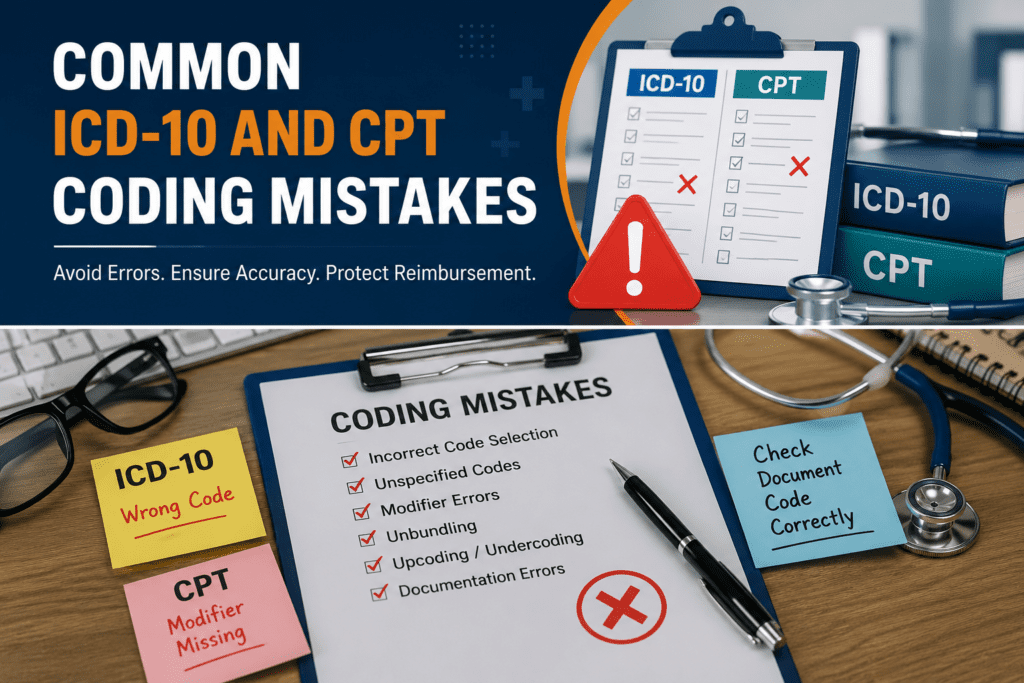
Common ICD-10 and CPT Coding Mistakes That Drive Denials
Let’s be direct. The two areas where practices lose the most money are diagnosis code selection and procedure code accuracy. One feeds the other. If the ICD-10 code does not support the medical necessity of the CPT code, the claim fails. It is that simple.
Unspecified Codes When Specificity Is Available
This one is everywhere. Coders reach for an unspecified ICD-10 code because it is faster, or because the documentation is unclear. For example, coding M54.5 for low back pain when the provider’s notes clearly indicate lumbar disc herniation at a specific level. The more specific code is available. The documentation supports it. But the coder defaulted to the unspecified option.
Payers notice this. Medicare, in particular, runs edits that flag high volumes of unspecified codes. Over time, it can trigger a medical necessity review or an audit. More immediately, it can lead to underpayment because the reimbursement weight for a more specific diagnosis is higher.
The fix is not complicated. Coders need to query providers when documentation is vague, and providers need to understand that specificity in their notes translates directly to accurate coding. (An internal link to your article on clinical documentation improvement would fit well here.)
Using Outdated Code Sets
ICD-10-CM and CPT are updated annually. Every October, ICD-10 changes take effect. CPT revisions from the AMA go live in January. It sounds obvious to say that practices should update their systems and train their teams. But claims submitted with deleted or revised codes still come through on audits regularly.
In 2023, the AMA revised dozens of E/M codes related to time-based billing. Practices that did not update their coding protocols accordingly were either undercoding or billing codes that no longer existed in their current form. The result was either lost revenue or claim rejections.
Evaluation and Management Coding Problems
E/M coding is one of the highest-risk areas in outpatient and hospital-based billing. The 2021 AMA changes to office visit coding shifted the framework significantly, moving away from documentation-based level selection toward medical decision-making complexity and total time.
Selecting the Wrong E/M Level
Undercoding happens when providers default to lower-level codes out of caution, especially in practices that are worried about audits. A level 3 office visit gets billed when the complexity of the encounter clearly supports a level 4. Multiply that by hundreds of patients per month, and the revenue loss is real.
Upcoding is the opposite problem, and it carries compliance risk. Billing a 99215 for a straightforward acute visit without the documentation to back it up is a common audit finding. The risk is not just a denial. It can mean repayment demands and penalties under the False Claims Act if it shows a pattern.
Modifier Misuse
Modifier 25 is supposed to indicate that a significant, separately identifiable E/M service was provided on the same day as a procedure. It gets misapplied regularly. Practices sometimes append it to every E/M that falls on a procedure day, without documenting why the visit was actually separate and distinct from the procedure itself.
Modifier 59 is another one that gets overused. It is meant to indicate a distinct procedural service and is often applied to bypass NCCI edits without proper justification. CMS has developed more specific modifiers (XE, XS, XP, XU) specifically because modifier 59 was being used too broadly. If your practice is still defaulting to modifier 59 for everything, that is worth reviewing.
Procedure Code Errors Beyond Modifiers
Unbundling
Unbundling means billing separately for services that should be reported under a single comprehensive code. It is one of the most common findings in coding audits, and it is not always intentional. Sometimes, coders are working from charge capture sheets that list individual components, not realizing that a bundled code exists.
For instance, billing individual debridement codes when a comprehensive wound care code covers the full encounter is a classic example. NCCI edits exist to catch many of these scenarios, but not all payers use the same edits, and some unbundling slips through.
Incorrect Place of Service Codes
This one gets overlooked because it feels like an administrative detail, not a clinical one. But the place of service codes affect reimbursement rates significantly. A service performed in a facility setting is reimbursed differently than the same service in a non-facility setting because the overhead calculation is different. Billing a non-facility POS code for a hospital-based procedure inflates the reimbursement rate. Payers flag this, and it creates both denial risk and compliance exposure.
Telehealth coding has added another layer to this issue. Post-pandemic billing rules for telehealth have shifted, and the POS and modifier requirements vary by payer. Many practices are still applying pre-2020 rules to telehealth encounters, which is generating avoidable rejections.
Documentation and Sequencing Errors
Good coding requires good documentation. There is no way around that. When provider notes are vague, incomplete, or contradictory, coders are forced to make judgment calls that may not hold up under review.
Primary Diagnosis Selection
Sequencing errors are more common than most practices want to admit. Selecting the wrong primary diagnosis changes the entire reimbursement picture. In inpatient coding, the principal diagnosis drives the DRG assignment, which drives the payment. In outpatient settings, the first-listed diagnosis needs to reflect the reason for the visit, not an incidental finding or a chronic condition that was simply noted.
Chronic condition coding is another area with consistent errors. Conditions like hypertension, diabetes, and chronic kidney disease should be coded whenever they are addressed or documented as relevant to the encounter. Many practices undercode these because coders are not sure whether the provider “addressed” them or simply acknowledged them. That ambiguity costs money and affects quality metrics.
Reducing Risk with Audits and Ongoing Training
The practices that control coding error rates best are the ones that treat coding accuracy as an ongoing process rather than a one-time training event. Regular internal audits, monthly error rate tracking, and structured coder education tied to denial trends make a measurable difference.
Payer-specific rules also require attention. Medicare and Medicaid have LCD and NCD requirements that commercial payers do not always mirror. What passes through one payer may be denied by another for the same service. Coders who work across multiple payer mixes need current, payer-specific reference materials.
The AMA maintains current CPT guidelines at ama-assn.org, and CMS publishes ICD-10-CM coding guidelines annually at cms.gov. Both are essential references for any billing team doing the work seriously.
Accuracy Is the Foundation of a Healthy Revenue Cycle
Common ICD-10 and CPT coding mistakes are not inevitable. Most of them trace back to documentation gaps, outdated training, or shortcuts that became habits. The good news is that each one of those root causes is addressable with the right systems and the right mindset.
Accurate coding protects reimbursement, reduces audit exposure, and supports compliance. It is not about being perfect on every claim. It is about building workflows where errors get caught early, patterns get reviewed regularly, and providers and coders stay aligned on what the documentation needs to show.