

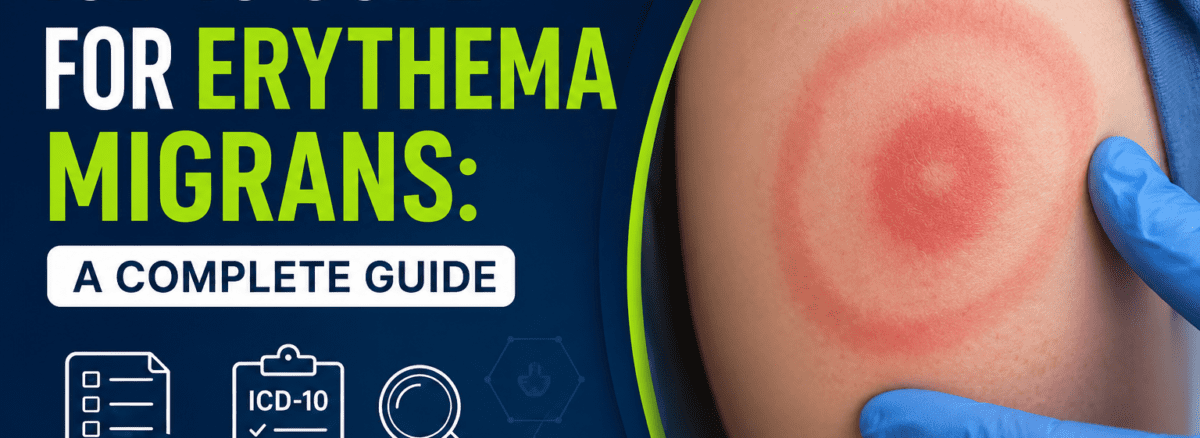
ICD 10 code for erythema migrans. If you are a medical coder, clinician, or billing specialist, it can be confusing to find the correct ICD 10 code for erythema migrans – especially when multiple codes exist, and the wrong one gets a claim rejected.
Zanemed has worked with medical documentation for years. We know the irritation of second-guessing a code, running it through a reference tool, and still not being 100% sure. This article is written to clear that confusion once and for all.
What Is Erythema Migrans?
Erythema migrans is the classic bull’s-eye rash that appears as an early sign of Lyme disease. It begins at the site of a tick bite and gradually spreads outward. This rash is caused by the bacterium Borrelia burgdorferi, a spirochetal infection transmitted through infected tick bites.
The rash is also called erythema chronicum migrans or erythema chronica migrans. It is typically the earliest visible sign of acute Lyme disease and appears within 3 to 30 days after a tick bite.
However, not all patients develop this rash, but when they do, proper documentation matters greatly – for treatment, reporting, and reimbursement.
Primary ICD 10 Code for Erythema Migrans You Need to Know
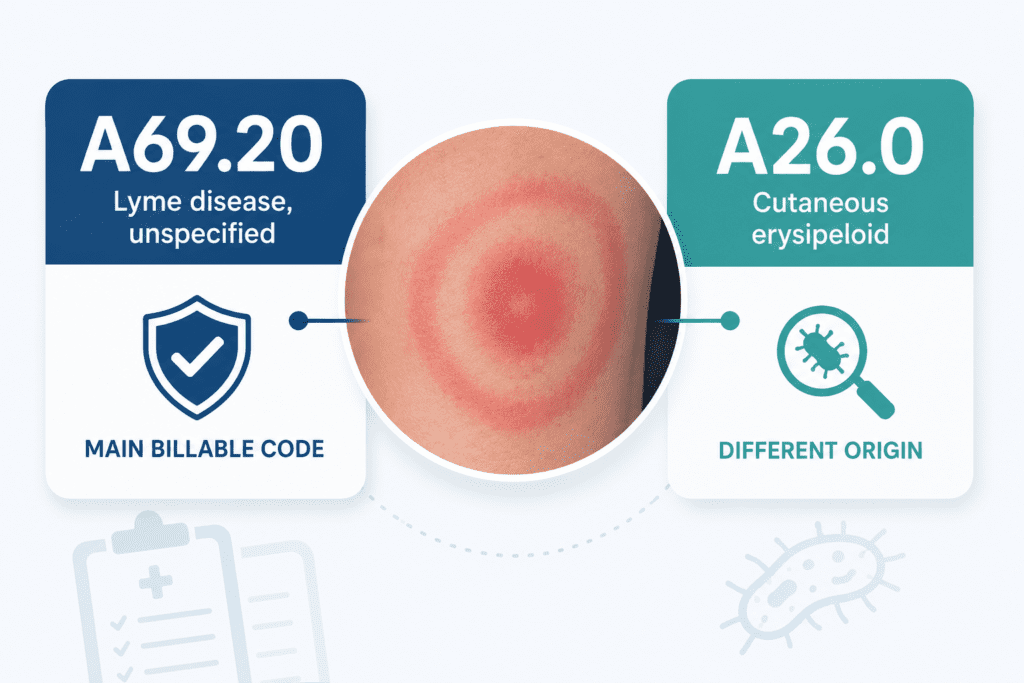
A69.20 – The Main Billable Code
The most commonly used and billable code is A69.20, which stands for Lyme disease, unspecified. This is the code most commonly used in clinical scenarios where erythema migrans is the primary sign of Lyme disease.
- It falls under A69.2, which is the non-billable parent code for Lyme disease
- A69.2 is used for grouping purposes but cannot be submitted for billing
- Always go with A69.20 for claims – it is the specific, billable code
A26.0 – When the Origin Is Different
There is another relevant code: A26.0, which covers cutaneous erysipeloid – sometimes listed under erythema migrans with an erysipeloid origin.
This code applies when the skin condition is caused by Erysipelothrix rhusiopathiae rather than Borrelia burgdorferi. Although it is less common, ignoring it can lead to miscoding.
How These Codes Fit in the ICD-10-CM Structure
The ICD-10-CM diagnosis code system categorises erythema migrans under two different categories depending on origin:
- A00–B99 covers infectious and parasitic diseases
- A65–A69 includes other spirochetal infections (where A69.20 sits)
- A20–A28 covers certain zoonotic bacterial diseases (where A26.0 sits)
Understanding the tree structure helps coders find the right code faster during a diagnosis code search.
Differential Diagnoses and Their ICD Codes
One of the biggest pain points for coders is identifying erythema migrans from appearance-based similar conditions. Here is a quick reference for related diagnoses:
Figurate and Annular Erythemas
- Erythema annulare centrifugum → L53.1
- Erythema marginatum → L53.2
- Other chronic figurate erythema → L53.3
- Erythematous condition, unspecified → L53.9
Other Erythema Types
- Erythema multiforme, unspecified → L51.9
- Erythema multiforme minor → L51.0
- Erythema nodosum → L52
- Toxic erythema → L53.0
- Erythema intertrigo → L30.4
- Erythema ab igne → L59.0
Infectious Erythemas
- Erythema infectiosum (Fifth disease) → B08.3 – caused by parvovirus B19, common in children
All of these lie within or near the urticaria and erythema range (L49–L54) in the ICD-10-CM classification.
Getting these codes mixed up is more common than you think – particularly in cases where the physician’s note is unclear or incomplete.
ICD 10 Erythema Migrans: Coding Notes and Excludes
When using A69.20 or related codes, always check the Applicable To and Type 1 Excludes notes in your ICD-10-CM manual or lookup tool. These notes tell you:
- What conditions are included under a code
- What conditions must be coded elsewhere
- Whether a combination code exists
For tick-borne diseases, the doctor’s notes should list the causative organism and symptoms. If Borrelia burgdorferi is noted with a skin rash, use code A69.20.
2026 ICD-10-CM Update: What to Check
For 2026 ICD-10-CM codes, always verify your codes at the start of each financial year. While A69.20 has been stable, code additions and revisions happen every year. Use a reliable diagnosis code reference and cross-check with the official CMS release before submitting claims.
ICD-9-CM Legacy Conversion
For older records, the ICD-9-CM code for Lyme disease was 088.81. Coding teams working with legacy data or chart reviews should note this carefully. The switch to ICD-10 added more detail, so Lyme disease is now split into multiple subcodes.
Practical Tips for Coders and Clinicians
Here are a few things I always recommend based on real-world experience:
- Document clearly. The physician’s note should specify “erythema migrans consistent with Lyme disease” — unclear notes lead to unspecified codes and possible corrections.
- Know the billable vs non-billable difference. A69.2 (parent) ≠ A69.20 (billable). One gets paid, the other doesn’t.
- Check for co-infections. Tick-borne disease cases sometimes include more than one pathogen. Code all verified conditions.
- Use current-year codes. An outdated code, even by one version, can trigger a denial.
Final Thoughts
- A69.20 is the correct, billable ICD 10 code for erythema migrans when associated with Lyme disease
- A26.0 applies in cutaneous erysipeloid cases with erythema migrans presentation
- Know your differentials – conditions like erythema multiforme, erythema nodosum, and erythema infectiosum have completely separate codes
- Always confirm with the latest 2026 ICD-10-CM code set before submitting
Getting this right protects both the patient record and the revenue cycle. Whether you are a coder, a physician, or a billing manager, the right coding for skin presentation Lyme disease starts with understanding what the code truly represents.
Always cross-reference with the official ICD-10-CM guide or a verified reference tool. Coding guidance changes every year.