


CO-45 in medical billing is a common question in healthcare offices. CO-45 is an insurance adjustment code that means the provider charged more than the allowed amount set by the insurance company. The extra amount cannot be billed to the patient and must be written off. In simple terms, it shows the difference between what was billed and what the insurer agreed to pay.
CO-45 is one of the most common adjustment codes you’ll see, and yet it still confuses many billing teams, especially those who are newer to revenue cycle management.
This guide breaks it down in plain language — what CO-45 means, why it shows up on your claims, what it does to your revenue, and how to stop it from becoming a recurring headache.
What Does CO-45 Actually Mean?
The letters and numbers here each have a meaning. “CO” stands for Contractual Obligation. The number “45” tells you the specific reason — the billed charges go beyond the maximum allowable amount fixed by the payer’s fee schedule.
So when you see CO-45, the payer is basically saying: “We know you charged $300, However, according to our agreement, the highest amount we will reimburse for this service is $180, and the remaining balance will be adjusted.”
This is called a contractual write-off. It’s not a denial. It’s an adjustment — a payment adjustment based on the terms you accepted when you signed the provider-payer agreement. . The CO-45 adjustment code falls under the Claim Adjustment Reason Code (CARC) system, which is a standardized list used by all insurance payers to explain why a payment differs from the billed charge.
Claim Adjustment vs. Claim Denial: Key Difference
Many billing teams get nervous when they see CO-45 because they think it’s a denial. It’s not. A claim rejection happens when the claim wasn’t processed at all, while a denial occurs when the payer reviews it and refuses to pay. An adjustment — like CO-45 — means the claim was paid, just at a different rate than what you billed.
Think of it this way: as an in-network provider, you’ve agreed to a contracted rate. If you bill more than that rate, the payer adjusts the payment down to the agreed amount. . That reduction shows up as CO-45 on your Explanation of Benefits (EOB) or Electronic Remittance Advice (ERA).
Where Does CO-45 Show Up?
You’ll typically find CO-45 on your EOB from the insurance company or on the ERA sent through your clearinghouse. These documents detail each service line, what was billed, what was allowed, and the payment made by the insurer— along with the adjustment codes explaining any differences.
Here’s an easy example of what it looks like in practice:
Billed Amount: $450
Payer’s Allowable Amount: $210
CO-45 Adjustment: -$240
Insurance Payment: $168
Patient Responsibility (copay/deductible/coinsurance): $42
That $240 is a contractual adjustment that cannot be charged to the patient . This is a critical compliance point — more on that in a moment.
Why Does CO-45 in Medical Billing Keep Appearing on Claims?
This is where it gets interesting. Not every CO-45 is expected or correct. Yes, some are routine — you billed above the fee schedule, the payer adjusted down, and that’s normal. But sometimes CO-45 shows up when it shouldn’t, and that represents real revenue leakage.
Here are the most common reasons CO-45 appears on claims:
1. Outdated or Incorrect Fee Schedules
Fee schedules are updated frequently — Medicare modified theirs annually, and commercial payers may revise theirs on their own timelines. If your billing system is still running on last year’s rates, you may be billing at amounts that don’t match the current payer agreement, leading to unnecessary adjustments.
2. Wrong CPT or HCPCS Codes
Coding discrepancies are a big driver. If an incorrect CPT or HCPCS code is used for a service, the payer will reimburse based on what that code allows — which may be far lower than the service actually rendered. The difference shows up as a CO-45 adjustment, even though the real problem is a coding error.
3. Missing or Wrong Modifiers
Modifiers tell the payer important context about how a service was performed. A missing modifier can cause the claim to be reimbursed at a lower rate. For example, certain procedures billed without the correct bilateral or technical component modifier may trigger a CO-45 because the payer prices them differently without that context.
4. Misapplied Contract Rates by the Payer
Sometimes the error is on the payer’s side. The insurance company may apply the wrong fee schedule to your claim — especially if you have multiple contracts with the same payer (like different rates for different facilities). This results in an unjustified CO-45, and you have every right to appeal it.
5. Coordination of Benefits Issues
Coordination of Benefits (COB) miscalculations between primary and secondary payers can also trigger CO-45 adjustments. If the secondary payer incorrectly calculates based on the primary’s allowable instead of the billed charge, the math can produce an adjustment that shouldn’t be there.
6. High-Deductible and Plan-Specific Differences
Patients enrolled in high-deductible plans can make this confusing. The payer still applies the contracted rate — and the CO-45 adjustment still happens — but the patient is responsible for more of the allowable amount until their deductible is met. The plan-specific allowable amounts vary widely between PPO and HMO structures, which can affect how CO-45 appears on different claims for the same service.
7. Manual Charge Entry Errors
Human error during manual charge entry can result in billed amounts that are higher than planned — or linked to the wrong service. These errors feed directly into CO-45 adjustments that should never have happened.
CO-45 and Patient Responsibility: Important Rules
Here’s one of the most important things to understand about CO-45 — and one of the biggest compliance risks for practices that get it wrong.
The CO-45 write-off amount is NOT the patient’s responsibility. You cannot bill patients for the difference between what you billed and the payer’s contracted rate. Doing so is called balance billing, and it’s prohibited for in-network providers under most payer contracts — and in many states, it’s illegal.
What patients can owe are their copay, deductible, and coinsurance — their share of the payer’s allowable amount. That’s it. The CO-45 portion is absorbed as a contractual write-off by the provider.
If your billing staff is unclear on this, it needs to be addressed quickly. Billing patients for contractual adjustments creates serious compliance violations and diminishes patient trust.
How to Prevent CO-45 Denials and Leakage
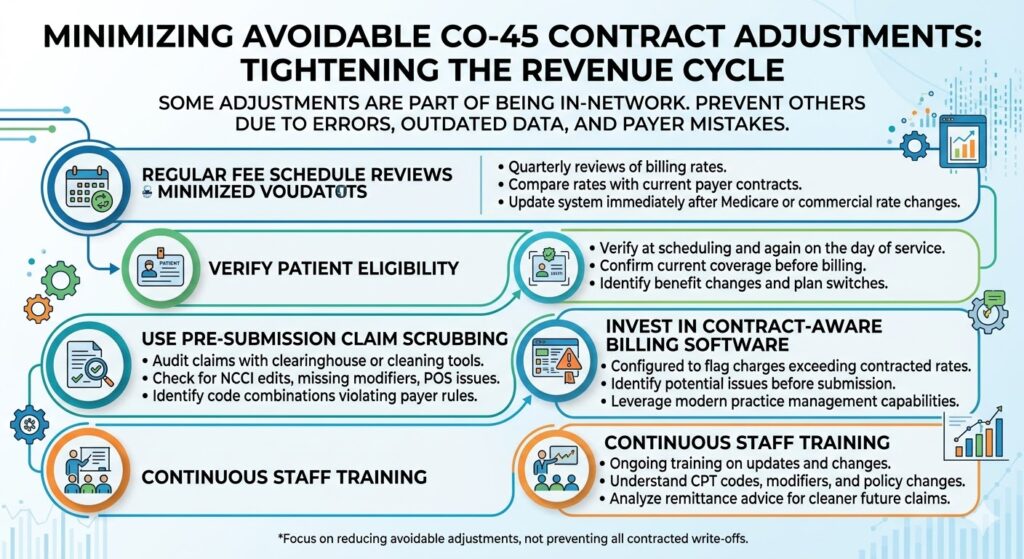
Not all CO-45 adjustments can be prevented — some are simply part of operating as an in-network provider. But the ones that happen due to errors, outdated data, or payer mistakes? Those are avoidable. Here’s how revenue cycle teams can tighten things up:
Do Regular Fee Schedule Reviews
A quarterly fee schedule review is not optional if you want to stay on top of this. Compare your billing rates to current payer contracts. When Medicare or commercial payers update their rates, your system needs to update those changes before you submit claims.
Verify Patient Eligibility Before Every Visit
Eligibility verification at the point of scheduling — and again on the day of service — can avoid a surprising number of issues. Patient benefits change. Plans switch. Knowing the patient’s current coverage ensures you’re billing the right payer under the right terms.
Use Claim Scrubbing Before Submission
Pre-submission claim audits through a clearinghouse or claim cleaning tool catch errors before the claim ever leaves your system. These tools check for NCCI edits, missing modifiers, place-of-service coding issues, and code combinations that won’t pass the payer’s rules — all of which can lead to CO-45 adjustments.
Invest in Contract-Aware Billing Software
Modern practice management systems can be configured to flag when a charge surpasses the contracted rate for a specific payer. This gives your team a chance to correct it before submission instead of finding out later through an adjustment.
Train Your Billing Staff Continuously
Billing staff training should be ongoing — not just a one-time onboarding event. Coding updates, payer policy changes, and new NCCI edits come out regularly. Staff who understand how to apply the right modifier, choose the right CPT code, and by analyzing remittance advice, you will submit cleaner claims and catch more issues early.
4. How to Appeal a CO-45 Adjustment
Not every CO-45 should be written off without question. If you believe a CO-45 was applied incorrectly — maybe the payer used the wrong fee schedule, or the adjustment doesn’t match your contract terms — you have the right to appeal.
Here’s a practical approach to the CO-45 appeal process:
• Act within the timeline. Most payers need appeals to be filed within 90 to 120 days of the remittance date. Miss this window and you lose your right to appeal.
• Pull your payer contract. Review the specific fee schedule or rate table for the service in question. If the payer paid lower than your contracted rate, you have a documented basis for appeal.
• Gather supporting documentation. Include the fee schedule excerpt, the original claim, the ERA showing the adjustment, and any payer communications.
• Follow the payer’s appeal guidelines. Each payer has a specific process — some accept appeals by mail, others through a portal. A corrected claim submission may also be relevant if the underlying issue was a coding error on your end.
• Track every appeal. Document the date filed, the reference number, and the outcome. This data helps identify patterns of insurance underpayment that need to be managed at the contract level.
CO-45 vs. Other Common Denial Codes
It helps to understand CO-45 in context with other adjustment and denial codes you’ll regularly encounter:
CO-18: This is a duplicate claim denial. It means the payer already processed this claim. Unlike CO-45, CO-18 means no payment was made.
CO-97: This denial code means the benefit for the service is included in the allowance or reimbursement for another service. In other words, the procedure can’t be billed separately.
Where CO-45 is an expected part of in-network billing, CO-18 and CO-97 often point to billing errors or process gaps that need to be corrected.
The Revenue Impact: Why This Matters at Scale
Individual CO-45 adjustments might look small — a few hundred dollars here and there. But across a busy practice or health system, the cumulative effect on cash flow can be significant.
Revenue integrity depends on catching two things: lawful contractual adjustments that should be written off, and unjustified reductions that should be appealed or corrected. If your denial management process doesn’t differentiate between the two, you’re either leaving money on the table or wasting time chasing adjustments that were always going to be written off.
Strong first-pass claim acceptance rates decrease the frequency of any post-payment adjustment review. The aim is to submit clean claims with right codes, correct modifiers, and verified patient information — so your reimbursement comes in as expected, and the only CO-45 adjustments you see are the ones that were always going to happen under your contract.
Final Thoughts on CO-45
CO-45 in medical billing is one of those codes that looks straightforward on the surface but actually involves a lot of complexity underneath. At its core, it’s telling you that the billed amount exceeded the payer’s contracted rate. That’s often expected — but not always acceptable.
The billing teams that manage well are those who know the difference between a routine write-off and an unwarranted adjustment. They update their fee schedules regularly, verify benefits before appointments, submit clean claims through proper claim scrubbing, and don’t hesitate to appeal when the numbers don’t match the contract.
If your practice is seeing CO-45 more than expected, or if your write-off totals are creeping up quarter after quarter, it’s worth doing a deep dive into your denial management workflows, your payer contract monitoring process, and your billing staff’s training on code selection and modifier application.
Revenue cycle management is never just about getting claims out the door — it’s about making sure the right amount comes back in.