Texas IDR specialists

Texas IDR Services for Out of Network Claims

ZanexMed files and manages Texas Department of Insurance arbitration for physicians and mediation for facilities, including freestanding ERs, and checks every claim against the federal process so it goes down the right route.

Billing support specialist working at her desk

Arbitration for providers

ER physicians, anesthesia and other clinicians.

Mediation for facilities

Freestanding ERs and hospitals.

Right route every time

Texas or federal IDR checked per claim.

Every deadline tracked

From the first payment date onward.

What Is Texas IDR?

Texas IDR is the state dispute process for out of network claims on plans regulated by the Texas Department of Insurance (TDI). It was created by Senate Bill 1264 and applies to services provided on or after January 1, 2020.

It covers out of network emergency care, certain services from out of network providers at in network facilities, and lab or imaging tied to in network care. The patient is kept out of the dispute: the provider and the health plan settle the amount between themselves.

Texas uses two tracks. Arbitration is for physicians and other providers, and the decision is binding. Mediation is for facilities such as freestanding ERs and hospitals. Federal claims follow the No Surprises Act instead. Both Texas tracks are filed through the TDI IDR portal.

Texas Arbitration and Mediation Timelines

Texas deadlines start from the date you receive the first claim payment. A request filed too early or too late is rejected, so we track every date from day one.

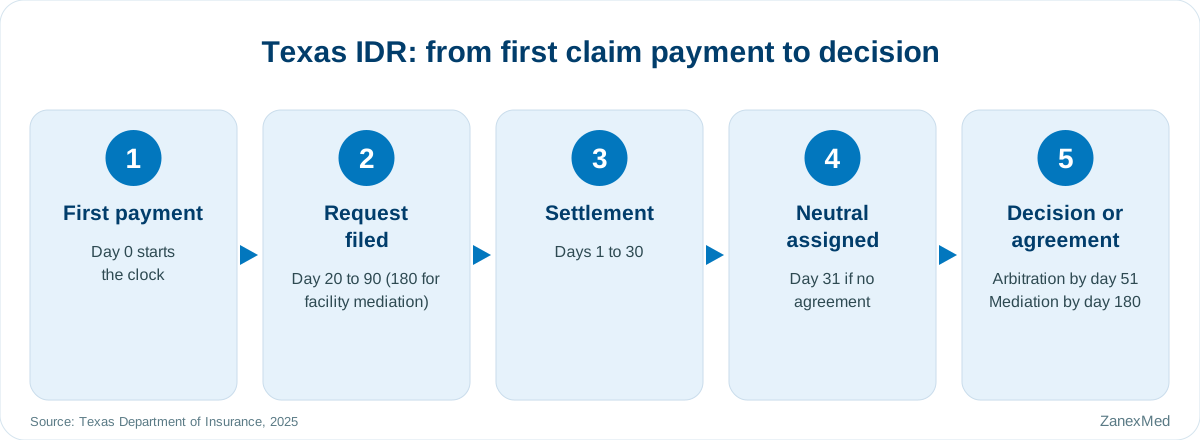
Texas IDR timeline from first claim payment to arbitration decision or mediation agreement
StepArbitration (providers)Mediation (facilities)
Request window20 to 90 days after the first claim payment20 to 180 days after the first claim payment
Informal settlementDays 1 to 30Days 1 to 30
Neutral assignedDay 31, if the parties have not agreed on an arbitratorDay 31, if the parties have not agreed on a mediator
ReviewDays 31 to 51Days 31 to 180
OutcomeBinding decision by day 51Mediation conference by day 180, report within 45 days
Billing team reviewing printed claim documents

How Our Texas IDR Services Work

Six steps for every Texas claim, with each TDI deadline tracked from the first payment date.

1. Plan and route check

We confirm the plan is state regulated and choose Texas or federal IDR.

2. Internal appeal

We use the internal appeal with the plan first, as TDI asks providers to do.

3. File on the TDI portal

We file arbitration or mediation inside the correct request window.

4. Informal settlement

We negotiate in the 30 day settlement period, where most cases close.

5. Evidence and offer

We build the case around the factors the arbitrator must weigh.

6. Collect and report

We track the decision or agreement until the payment is posted.

Which Texas Claims Qualify

Not every claim qualifies for the Texas process. We check each one before anything is filed.

Services

Plans

Texas IDR vs Federal IDR: Which Applies

The plan decides the route. Fully insured plans regulated by TDI, ERS, TRS and self funded plans that opted in use the Texas process. Most other self funded employer plans are regulated under ERISA and use the federal IDR process under the No Surprises Act.

State regulated plans often carry a TDI or DOI mark on the member ID card, but we always confirm with the plan before filing, because the wrong route can end the claim.

Emergency physician in a white lab coat

What Texas Arbitrators Consider

Texas arbitrators must weigh ten factors set by TDI. They include the 80th percentile of billed charges and the 50th percentile of in network rates for the same service, specialty and area in the FAIR Health database, the provider training and experience, the complexity of the case, the network contracting history between the parties, and any offer made during the settlement teleconference.

Each arbitrator charges a fixed fee per case, and each side pays half once an arbitrator is assigned. A well documented offer made early is the fastest way to get paid.

782,679

Texas arbitration requests settled in the first 30 days

169,228

Texas arbitration requests decided by an arbitrator

Texas Department of Insurance data, January 2020 to October 7, 2025. Source

Texas IDR FAQs

Quick answers on Texas arbitration, mediation and deadlines.

Texas IDR is the state process for settling out of network payment disputes between providers and plans regulated by the Texas Department of Insurance. It was created by SB 1264 and covers services on or after January 1, 2020.
Arbitration is for physicians and other providers, and the arbitrator decision is binding. Mediation is for facilities such as freestanding ERs and hospitals, where a mediator helps both sides reach an agreement.
Between 20 and 90 days after you receive the first claim payment. Facility mediation can be requested between 20 and 180 days after the first payment.
Each arbitrator sets a fixed fee per case, and the provider and the plan each pay half once an arbitrator is assigned.
Yes. Freestanding ERs use the mediation track for facility claims. TDI data shows freestanding ERs filed about 73 percent of all Texas mediation requests from 2020 to October 2025.
Only if the self funded plan has opted in to the Texas process. Other self funded ERISA plans go through the federal IDR process instead.
The decision is binding, but either party may file a civil action within 45 days after the decision.
Pricing depends on claim volume and value. See our pricing page or contact us for a quote, and use the free IDR Claim Checker to test a claim.

Ready to Recover Underpaid Texas Claims?

Send us your underpaid out of network claims and we will check which ones qualify for Texas or federal IDR, free.

Get a Free Claim Review

Tell us about your practice and a billing specialist will contact you.


    Scroll to Top