

REVENUE CYCLE MANAGEMENT
EDI Medical Billing Services for Faster Claims and Payments
- Payer EDI, ERA and EFT enrollment handled
- 837, 835, 270/271 and 276/277 transactions
- Rejections fixed before they become denials
Table of Contents
What Are EDI Medical Billing Services?
EDI (electronic data interchange) medical billing services handle the standard electronic transactions that practices and payers use to exchange claims, eligibility, remittances and claim status. Instead of paper forms and phone calls, each transaction travels as a standardized file through a clearinghouse or a direct payer connection.
HIPAA requires covered entities to use standard formats for these transactions. The most common are the 837 claim, the 835 electronic remittance advice (ERA), the 270 and 271 eligibility inquiry and response, and the 276 and 277 claim status request and response.
Good EDI setup is mostly invisible. Claims go out clean, ERAs arrive on time and payments post automatically. Poor setup causes rejections, missing remittances and payment delays. You can read the federal rules in the HIPAA transaction standards published by the Centers for Medicare and Medicaid Services.
EDI Transactions We Manage
| Transaction | What it does | Why it matters |
|---|---|---|
| 837P and 837I | Sends professional or institutional claims to the payer | Gets claims to payers quickly with fewer errors |
| 835 (ERA) | Returns payment and adjustment detail for each claim | Allows automatic payment posting |
| 270 and 271 | Checks eligibility and benefits | Prevents eligibility denials |
| 276 and 277 | Checks the status of a claim | Cuts phone calls to payers |
| 278 | Requests prior authorization | Speeds up authorization decisions |
| 999 and 277CA | Confirms that files and claims were received | Shows rejections within hours |
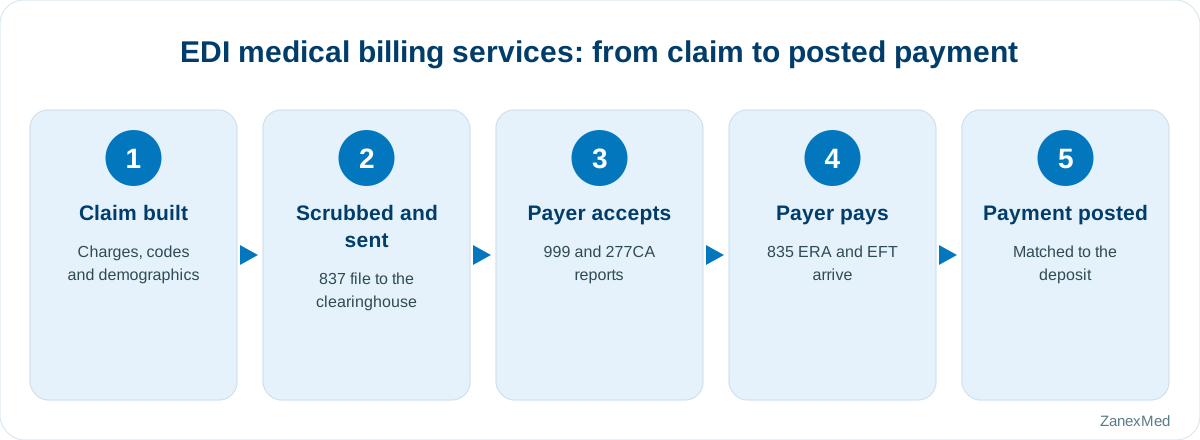
How Our EDI Medical Billing Services Work
1. Clearinghouse setup
We connect your practice system to a clearinghouse, or work with the one you already use.
2. Payer enrollment
We complete EDI, ERA and EFT enrollment with each payer and track it until it is active.
3. Claim scrubbing
Every claim is checked against payer rules and formatting edits before it is sent.
4. Submission and acknowledgments
We send the 837 file and review 999 and 277CA reports for rejections.
5. ERA and EFT reconciliation
Remittances are matched to claims and to the bank deposit.
6. Rejection monitoring
Rejected claims are fixed and resent as soon as the report arrives.
Benefits of EDI for Your Practice
- Faster payments than paper claims
- Fewer data entry errors
- Real time rejection alerts
- Automatic payment posting from ERAs
- Lower mailing and printing costs
- A clear audit trail for every claim
ERA and EFT Enrollment Done Right
Payers usually require separate enrollment for electronic remittance advice (ERA) and electronic funds transfer (EFT). Without it, you keep receiving paper EOBs and checks, and your team posts payments by hand.
ZanexMed completes ERA and EFT enrollment, tests the first remittances and connects them to payment posting so payments are applied correctly. If a payer pays below contract, the difference shows up in your billing reports.
GOT QUESTIONS?
EDI Medical Billing Services FAQs
What does EDI stand for in medical billing?
What is the difference between an 837 and an 835?
Do I need a clearinghouse?
How long does EDI and ERA enrollment take?
Does EDI reduce claim denials?
How much do EDI medical billing services cost?
RELATED SERVICES
Explore More ZanexMed Billing Services
Claim Submission
Clean electronic and paper claims tracked until paid.
Payment Posting
Accurate ERA and EOB posting with underpayment flags.
Claim Preparation
Checks that prevent rejections before submission.
Denial Management
Find the root cause of denials and appeal with proof.