

The CO 45 denial code means the amount you billed is higher than the payer allowed amount under your contract or fee schedule, so the difference is written off. Despite the word denial in its nickname, CO 45 is usually a routine contractual adjustment, not a rejected claim.
On this page you will learn what the CO 45 denial code means, how the adjustment is calculated, whether you can bill the patient, and how to spot the cases where CO 45 hides an underpayment.
CO 45 Denial Code at a Glance
- What it is: Claim Adjustment Reason Code (CARC) 45, which says the charge exceeds the fee schedule, maximum allowable amount or a contracted or legislated fee arrangement.
- Is it a denial? Usually no. It is the normal difference between your charge and the allowed amount.
- Who absorbs it: with the CO group code, the provider writes it off. With PR, the amount is patient responsibility.
- Can you bill the patient? Not for a CO 45 amount.
- What to check: whether the allowed amount matches your contract. If it is lower, you may have been underpaid.
Table of Contents
What Does the CO 45 Denial Code Mean?
The official wording of reason code 45 is that the charge exceeds the fee schedule, maximum allowable amount, or contracted or legislated fee arrangement. The code lists are maintained by X12 and published by Washington Publishing Company, and payers use them on every electronic remittance advice (ERA) and explanation of benefits (EOB).
The two parts of the code work together. CO is the group code for contractual obligation, which means the provider is responsible for the amount under the payer contract. 45 is the reason: the charge is above what the payer allows for that service.

The reason this code is everywhere is simple. Most practices set their charges above what any single payer will pay. The contract sets the allowed amount, and the difference has to be adjusted off the account. The CO 45 denial code is how the payer reports that difference.
Is CO 45 a Denial?
In most cases, no. A true denial means the payer refused to pay for the service. CO 45 usually appears on lines that were paid, and it simply shows the contractual write off. The X12 usage rules also say the CO 45 amount cannot equal the full service charge, which is another sign that it is not a rejection of the whole service.
Compare that with real denials such as the CO 16 denial code or the CO 50 denial code. Those stop payment and need a fix or an appeal. The CO 45 denial code normally needs no action on the claim itself.
It does deserve a second look when you see any of these signs:
- The allowed amount is lower than your contract rate for that code
- The same CPT code is adjusted differently from one claim to the next
- A large CO 45 amount appears on a service the payer normally pays well
- CO 45 appears on an out of network claim where no contract rate exists
- The payer used an old or wrong fee schedule
How the CO 45 Adjustment Is Calculated
The math is simple. Billed charge minus allowed amount equals the contractual adjustment. The allowed amount is then split between the payer payment and the patient share, such as a copay, deductible or coinsurance.
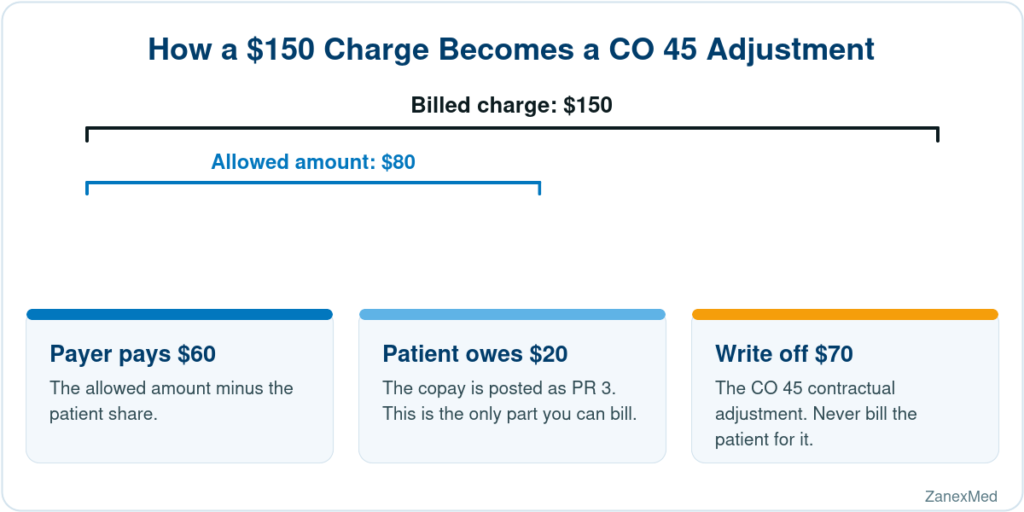
| Item | Amount | How it shows on the remit |
|---|---|---|
| Billed charge | $150 | Submitted on the claim line |
| Allowed amount | $80 | Set by the contract or fee schedule |
| Contractual adjustment | $70 | CO 45 |
| Patient copay | $20 | PR 3 |
| Payer payment | $60 | Allowed amount minus the patient share |
Check the numbers each time: $150 minus $70 equals $80, and $60 plus $20 equals $80. If the totals do not add up, something other than a normal CO 45 adjustment is going on.
CO 45 vs PR 45
Reason code 45 is one of the few codes that can be used with more than one group code. The group code tells you who carries the amount, so always read both halves of the code.
| Group code | Meaning | Who absorbs it | What to do |
|---|---|---|---|
| CO | Contractual obligation | The provider | Write it off and do not bill the patient |
| PR | Patient responsibility | The patient | Check the remark codes and plan rules before billing the patient |
| OA | Other adjustment | Neither | Usually used for coordination of benefits |
PR 45 is less common. When it appears, read the remark codes and the payer rules carefully before sending a patient statement.
Can You Bill the Patient for CO 45?
No. A CO adjustment is your contractual obligation. Billing the patient for the difference, known as balance billing, can breach your payer contract and, in many cases, state or federal law. The patient owes only the PR amounts: the deductible (PR 1), coinsurance (PR 2) and copay (PR 3).
Out of network care follows the same logic. For emergency services and certain other services covered by the No Surprises Act, which the Centers for Medicare and Medicaid Services explains, balance billing is also prohibited. That makes the gap between billed charges and the payer allowed amount a matter for negotiation or independent dispute resolution, not a patient bill.
How to Handle a CO 45 Adjustment
Treat every CO 45 adjustment with the same short routine. It takes a few seconds when the numbers are right and saves real money when they are not.
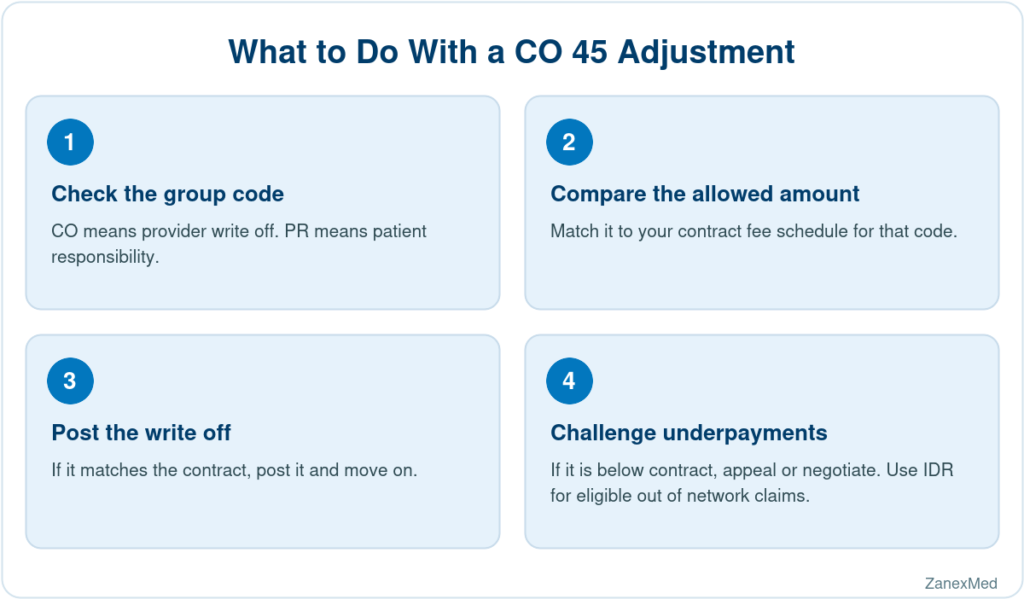
- Check the group code. CO means write off. PR means the patient may owe the amount.
- Compare the allowed amount. Match it to your contract fee schedule for that CPT code, modifier and place of service.
- Post the write off. If the allowed amount matches the contract, post the contractual adjustment and move on.
- Challenge underpayments. If the allowed amount is lower than the contract, appeal with the contract language. For eligible out of network claims, negotiate or file IDR.
When CO 45 Hides an Underpayment
A normal CO 45 and an underpayment look identical on the remittance. The code does not tell you whether the allowed amount was right. That is why practices that never review CO 45 adjustments can lose money every month without noticing.
| Check | What to compare | Red flag |
|---|---|---|
| Rate | Allowed amount against your contracted rate | Allowed amount is lower than the contract |
| Fee schedule | The year and the plan product used | An old or wrong fee schedule was applied |
| Modifiers and units | The claim against the remittance | A reduction with no clear explanation |
| Pattern | The same CPT code across many claims | Different allowed amounts for the same service |
Our medical payment posting services compare every allowed amount with your contract and flag claims paid below it, and the results appear in your billing reports. For out of network claims, the same review feeds out of network claim negotiation.
Common Causes of Unexpected CO 45 Adjustments
An unexpected CO 45 denial code almost always traces back to one of these causes:
- An outdated fee schedule loaded in the payer system or in your own billing system
- The claim was priced under the wrong contract or plan product
- A modifier or unit count that triggered a reduction
- Multiple procedure reductions applied to several services on one visit
- Payer repricing through a third party vendor
- No contract rate exists, as with out of network claims
- A chargemaster that is out of line with your contracts
How to Prevent CO 45 Leakage
Prevention is mostly about process. These habits keep the CO 45 denial code from hiding lost revenue:
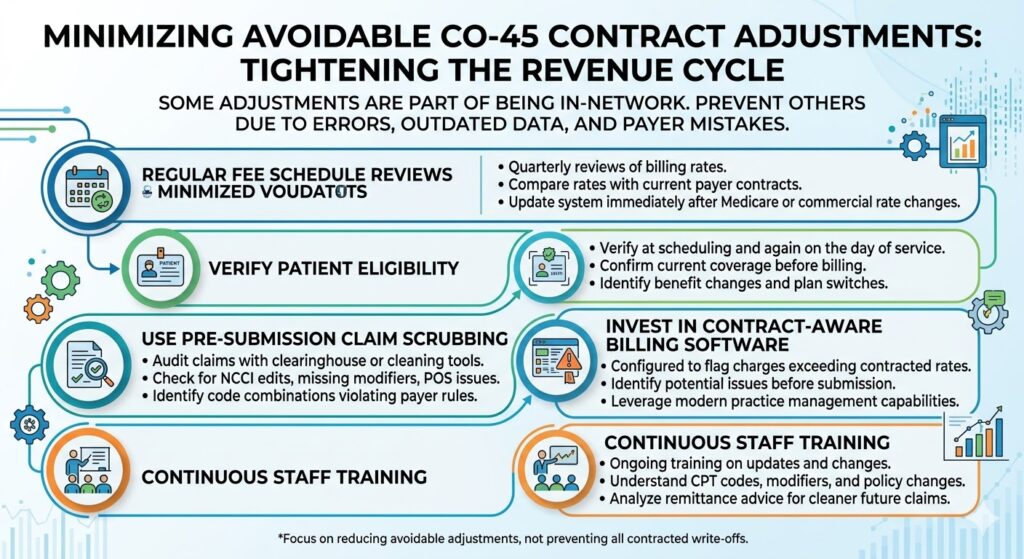
- Load current contracted rates for every payer into your billing system
- Compare allowed amounts with contract rates automatically during posting
- Post ERAs electronically so adjustments are captured line by line, as covered in our guide to payment posting in medical billing
- Run a monthly underpayment report by payer and CPT code
- Review payer contracts and fee schedules at least once a year
- Follow up on aging underpaid claims in your AR management process
- Track net collection rate and other metrics, as explained in our revenue cycle KPIs guide
CO 45 Compared With Other Adjustment Codes
Here is how the CO 45 denial code compares with the codes it is most often confused with.
| Code | Meaning | What it usually means for you |
|---|---|---|
| CO 45 | Charge exceeds fee schedule or contracted rate | Routine write off. Check the allowed amount. |
| CO 16 | Claim lacks information or has a billing error | A true denial. Correct the data and resubmit. See the CO 16 guide |
| CO 50 | Not deemed a medical necessity by the payer | A true denial. Appeal with records. See the CO 50 guide |
| CO 97 | Payment is included in the allowance for another service | Bundling. Review modifiers and coding. |
| CO 96 | Non covered charge | Read the remark code. Write off unless PR applies. |
| PR 1 | Deductible amount | Bill the patient |
| PR 2 | Coinsurance amount | Bill the patient |
| PR 3 | Copayment amount | Bill the patient or reconcile with the copay collected |
How ZanexMed Helps With CO 45 Adjustments
ZanexMed makes sure the CO 45 denial code stays what it should be, a harmless write off. Our payment posting services check every allowed amount against your contract, our reporting shows underpayment trends by payer, and our denial management services and IDR team go after the claims that were paid too little.
If you suspect payers are paying below your contracts, contact ZanexMed for a free review of your remittances.
CO 45 Denial Code FAQs
What does the CO 45 denial code mean?
The CO 45 denial code means the charge exceeds the fee schedule, maximum allowable amount or contracted fee arrangement. The difference between your charge and the allowed amount is written off as a contractual adjustment.
Is CO 45 a denial?
Usually no. It is a routine contractual adjustment that appears on most paid in network claims. A true denial, such as CO 16 or CO 50, stops payment for the service.
Can I bill the patient for CO 45?
No. CO is the group code for contractual obligation, so the provider absorbs the amount. The patient can only be billed for PR amounts such as the deductible, coinsurance and copay.
What is the difference between CO 45 and PR 45?
The group code decides who carries the amount. With CO, the provider writes it off. With PR, the amount is patient responsibility, which is less common and should be checked against the remark codes and plan rules.
Why is my CO 45 adjustment so large?
A large adjustment usually means your charge is much higher than the allowed amount, which is normal. It can also mean the payer used the wrong fee schedule or repriced the claim, so compare the allowed amount with your contract.
Should I appeal a CO 45 adjustment?
Only if the allowed amount is lower than your contracted rate. If the adjustment matches the contract, post it and move on. If it does not, appeal with the contract language and the fee schedule.
How do I know if CO 45 means I was underpaid?
Compare the allowed amount with your contract for that CPT code, modifier and place of service. If the allowed amount is lower than the contract, the CO 45 adjustment includes money you should have been paid.
Does CO 45 apply to out of network claims?
It can. When no contract rate exists, the payer may price against its own allowed amount. If the claim is covered by the No Surprises Act, you cannot bill the patient for the gap, and unresolved underpayments may qualify for negotiation and IDR.