

The CO 16 denial code means the payer could not process your claim because it lacks information or contains a submission or billing error. It is one of the most common denials in medical billing, and it nearly always arrives with a remark code that tells you exactly what is wrong.
If you are looking at a CO 16 denial right now, here is the good news: it is a data problem, not a medical necessity or coverage decision. In this guide you will learn what the CO 16 denial code means, why it happens, how to read the remark codes that come with it, and a simple six step process to fix and prevent it.
CO 16 Denial Code at a Glance
- What it is: a Claim Adjustment Reason Code (CARC) saying the claim lacks information or has a billing error.
- Who pays: CO is the contractual obligation group code, so the provider cannot normally bill the patient for the denied amount.
- What to read next: the remark code (RARC) on the ERA or EOB names the missing or wrong data.
- How to fix it: correct the data, then send a corrected claim or a new claim, as the payer directs.
- How to prevent it: verify data before submission, scrub claims and track repeat causes by payer.
Table of Contents
What Does the CO 16 Denial Code Mean?
CO 16 is a Claim Adjustment Reason Code, or CARC. Its official description is that the claim or service lacks information or has submission or billing errors. The code comes from the code lists maintained by X12, which payers use on every electronic remittance advice (ERA) and paper explanation of benefits (EOB).
The two parts of the code mean different things. CO is the group code for contractual obligation, which means the provider is financially responsible for the denied amount under the payer contract and normally cannot bill the patient. 16 is the reason: missing information or a billing error.
Notice what the CO 16 denial code does not say. The payer is not saying the service was unnecessary, not covered or a duplicate. It is saying the claim as submitted cannot be processed. Data problems are usually fixable, which makes this denial far easier to recover than a medical necessity denial such as the CO 50 denial code.
CO 16 Denial Code vs a Rejected Claim
People often mix the two up. A rejected claim is stopped before adjudication, usually by the clearinghouse or the payer front end, and you see it on an acknowledgment report such as a 277CA. A CO 16 denial shows up on the remittance after the payer has handled the claim. Both come from missing or wrong data. The difference is where in the process the claim stopped.
Fast submission and daily acknowledgment checks catch many problems early. Our guides to EDI medical billing and medical claim submission explain how those reports work.
Why the Remark Code Matters
The CO 16 denial code is sometimes called a wrapper code, because the real detail sits in the Remittance Advice Remark Code (RARC) attached to it. The CARC definition itself says at least one remark code must be provided. If you treat every CO 16 the same way, you will waste time, so always read both codes together.
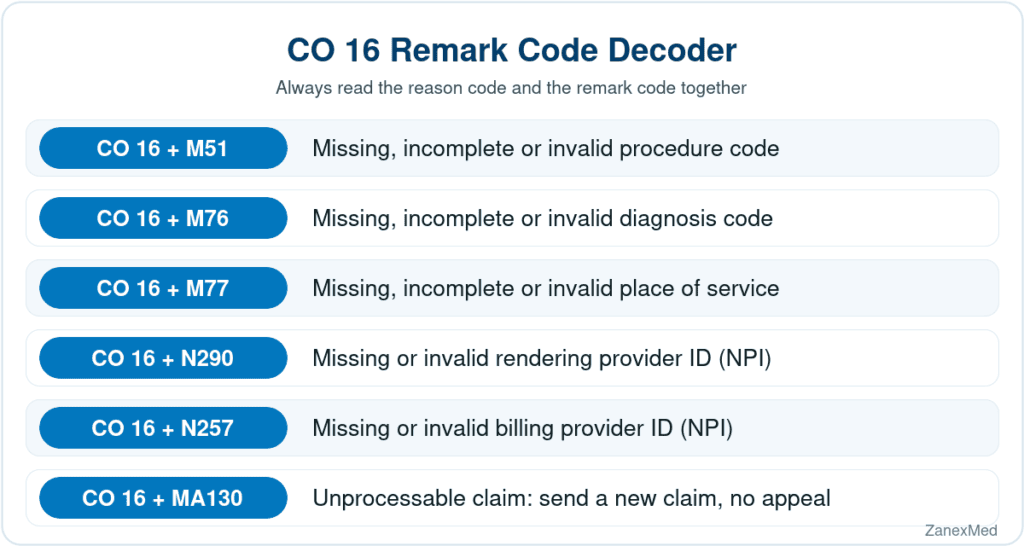
| Remark code | What it means | Typical fix |
|---|---|---|
| M51 | Missing, incomplete or invalid procedure code | Add or correct the CPT or HCPCS code and modifiers |
| M76 | Missing, incomplete or invalid diagnosis or condition | Add a valid ICD 10 code and link it to the service |
| M77 | Missing, incomplete or invalid place of service | Correct the place of service code |
| N290 | Missing, incomplete or invalid rendering provider identifier | Correct the rendering provider NPI |
| N257 | Missing, incomplete or invalid billing provider identifier | Correct the billing provider NPI and enrollment data |
| N264 and N265 | Missing or invalid ordering or referring provider information | Add the ordering or referring provider name and NPI |
| MA130 | Claim has incomplete or invalid information and is unprocessable, with no appeal rights | Send a new claim with the correct information |
Medicare contractors such as Noridian publish denial resolution guides for many CO 16 and remark code pairs, and they are a useful reference even if you bill commercial payers.
Common Causes of the CO 16 Denial Code
Most CO 16 denials trace back to a short list of data errors:
- Missing or invalid procedure code or modifier
- Missing diagnosis code, or a diagnosis not coded to the highest specificity
- Wrong or missing place of service
- Missing or invalid NPI for the rendering, billing or referring provider
- Missing ordering or referring provider details when the service requires them
- Patient demographics or subscriber ID that do not match payer records
- Missing units, charges or dates of service
- Missing required documentation, such as a certificate of medical necessity for some equipment
Data quality is the leading denial driver across the industry. In the Experian Health 2025 State of Claims survey, missing or inaccurate claim data was the top reason for denials, cited by 50 percent of providers, and 41 percent said denial rates are 10 percent or higher, as reported by Becker Hospital Review.
How to Fix a CO 16 Denial Step by Step
A clear routine turns a CO 16 denial from a mystery into a ten minute task. Follow these six steps in order.
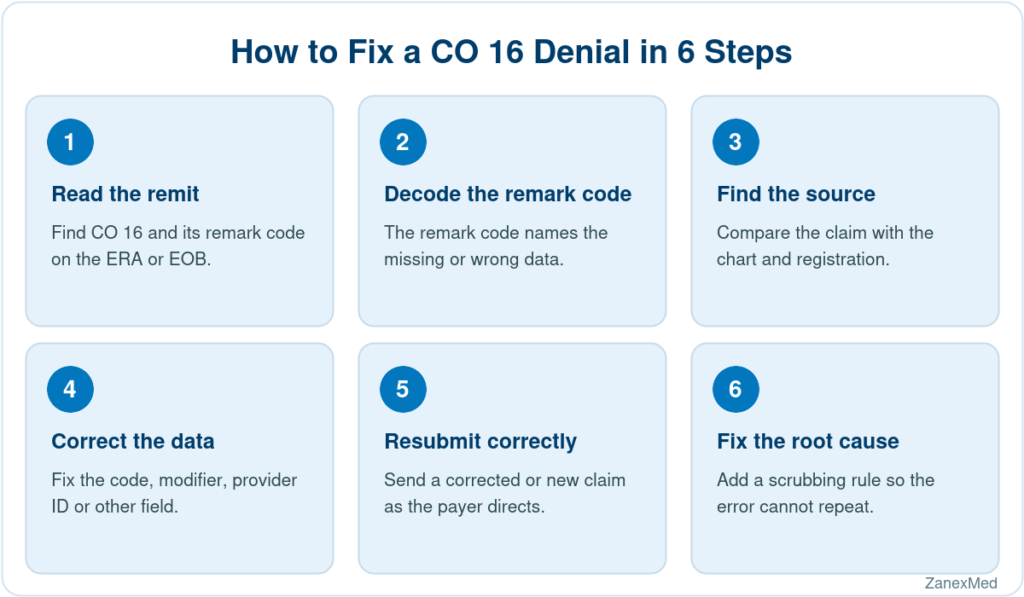
- Read the remittance. Open the ERA or EOB and note the claim number, the CO 16 code and every remark code on the claim or the service line.
- Decode the remark code. Look up the RARC in your payer code list or the X12 lists. It tells you which field is missing or wrong.
- Find the source of the error. Compare the submitted claim with the chart, the superbill, the patient registration and the provider enrollment record.
- Correct the data. Fix the field, code, modifier, place of service or provider identifier. If documentation is missing, add it.
- Resubmit the right way. If the remark code is MA130, the claim is unprocessable and has no appeal rights, so send a new claim with the correct data. For other CO 16 denials, follow the payer rules for corrected claims. That usually means a replacement claim with frequency code 7 and the original claim number, or a new claim if the payer asks for one.
- Track the cause and fix the root. Log the cause by payer and remark code, then add a scrubbing rule or a front desk fix so it does not repeat.
Watch the clock while you do this. A corrected claim must still reach the payer before the timely filing deadline, which varies by payer. Our timely filing limit guide explains the common deadlines.
CO 16 Denial Code Example
Here is an illustrative example. A freestanding emergency room submits a claim with two digits swapped in the rendering provider NPI. The ERA returns the CO 16 denial code with remark code N290. Billing compares the claim with the provider enrollment record, finds the swapped digits, corrects the NPI in the billing system and resubmits. The claim is accepted the second time. The team then adds a check that compares every rendering NPI with the enrollment file before a claim is released, so the same typo cannot reach a payer again.
How to Prevent CO 16 Denials
Fixing denials is necessary. Preventing them is cheaper. These habits cut the number of CO 16 denials a practice sees:
- Verify eligibility and patient demographics at scheduling and again before billing
- Keep provider NPIs, taxonomy codes and enrollment data accurate in your billing system
- Run every claim through a scrubber with payer specific rules, which is the core of our claim preparation services
- Code to the highest level of specificity and update code sets every year with the help of medical coding services
- Capture ordering and referring provider details whenever a service requires them
- Train front desk and charge entry staff on the required claim fields
- Review acknowledgment reports daily so rejections are fixed at once
- Report CO 16 denials by payer and remark code every month, as covered in our revenue cycle KPIs guide
Practices that track these numbers fix causes instead of claims. Our billing audit guide and the list of common medical billing errors are good next reads.
CO 16 Compared With Other Denial Codes
Each denial code has a different root cause and a different fix, so it helps to know how CO 16 differs from its neighbors. Unlike CO 16, the CO 45 denial code is usually a routine write off, not a true denial.
| Code | Meaning | Usual fix |
|---|---|---|
| CO 4 | The procedure code is inconsistent with the modifier, or a required modifier is missing | Correct or add the modifier and resubmit |
| CO 16 | Claim lacks information or has a submission or billing error | Read the remark code, correct the data and resubmit |
| CO 18 | Exact duplicate claim or service | Confirm the status of the original claim before resubmitting |
| CO 29 | The time limit for filing has expired | Send proof of timely filing if you have it |
| CO 50 | Not deemed a medical necessity by the payer | Appeal with clinical records, as explained in the CO 50 guide |
| CO 97 | Payment is included in the allowance for another service | Review bundling rules and modifiers |
How ZanexMed Helps With the CO 16 Denial Code
ZanexMed fixes CO 16 denials and, more importantly, stops them from coming back. Our claim preparation services check data before claims go out, our denial management services correct and resubmit denied claims by payer and deadline, and our medical AR management team follows every open claim until it is paid.
If the CO 16 denial code keeps showing up on your remittances, contact ZanexMed for a free review of your denial report.
CO 16 Denial Code FAQs
What does the CO 16 denial code mean?
The CO 16 denial code means the claim lacks information or has a submission or billing error, so the payer could not process it. The remark code that comes with it shows what is missing or wrong.
Can I bill the patient for a CO 16 denial?
Usually no. CO is the group code for contractual obligation, so the provider is responsible for the denied amount. Fix the claim and resubmit it instead of billing the patient.
Is CO 16 a rejection or a denial?
CO 16 appears on a remittance, so it is a denial adjustment. A rejection is stopped earlier, before adjudication, and appears on a clearinghouse or payer acknowledgment report. Both usually come from data errors.
What remark codes come with CO 16?
Common ones include M51 for procedure codes, M76 for diagnosis, M77 for place of service, N290 and N257 for provider identifiers, N264 and N265 for ordering or referring provider information, and MA130 for an unprocessable claim.
Can I appeal a CO 16 denial?
Most CO 16 denials are fixed by correcting the claim, not by appeal. If the remark code is MA130, there are no appeal rights and you must send a new claim with the correct information.
How long do I have to fix a CO 16 denial?
The deadline is the payer timely filing limit, which varies by payer and is often between 90 days and one year from the date of service. Check your payer contract and act quickly.
What causes the CO 16 denial code most often?
Missing or invalid procedure codes, diagnosis codes, place of service, provider identifiers and patient or subscriber data are the most common causes.
How do I prevent CO 16 denials?
Verify eligibility and demographics, keep provider identifiers accurate, scrub claims against payer rules, code to the highest specificity and review CO 16 denials by payer and remark code every month.