
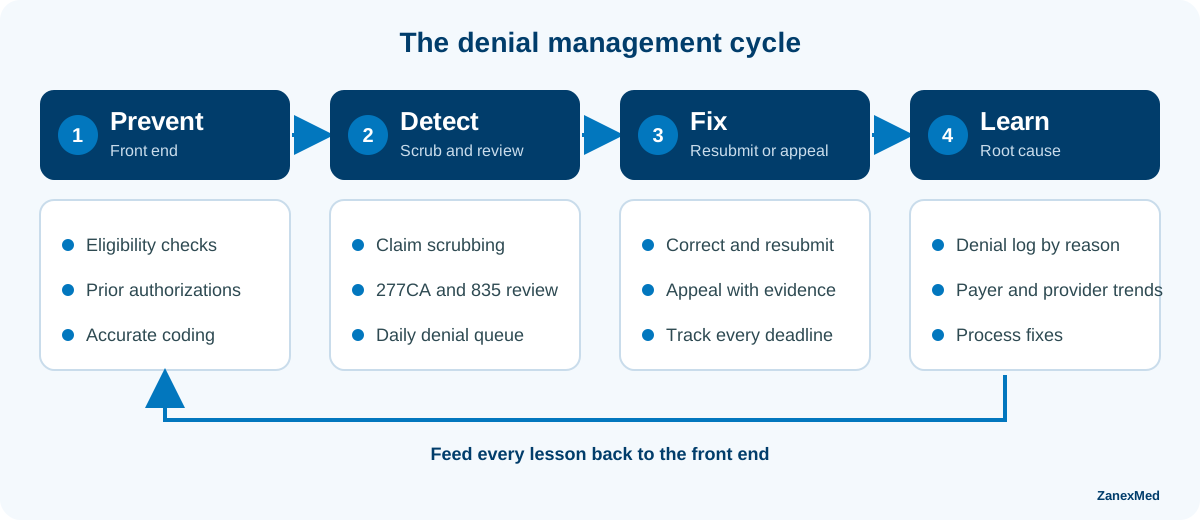
Medical billing denial management is the process of tracking, analyzing, correcting and preventing claim denials so more claims are paid on the first submission. The strategies that cut preventable denials fastest are front end eligibility and authorization checks, accurate coding, claim scrubbing before submission, quick denial triage, root cause analysis and well documented appeals.
This guide explains why claims get denied, shows eight practical strategies for medical billing denial management and gives you a KPI table, a workflow diagram and a checklist you can use this week.
Medical Billing Denial Management at a Glance
- Verify eligibility early: confirm coverage, plan type and benefits before the visit.
- Secure authorizations: get prior authorization and referrals on file before service.
- Code accurately: match codes, modifiers and diagnoses to the documentation.
- Scrub and file fast: catch errors before submission and meet timely filing limits.
- Triage denials daily: sort soft and hard denials and assign an owner to each one.
- Find the root cause: group denials by reason, payer, provider and code.
- Appeal with evidence: send clear letters with records, policy language and deadlines.
- Track KPIs: watch denial rate, first pass rate and appeal success every month.
Table of Contents
What Is Medical Billing Denial Management?
Denial management in medical billing is a structured workflow that prevents denials before submission, works every denied claim quickly and uses denial data to fix the process behind it. It covers the front end, such as eligibility and authorization, and the back end, such as appeals and A/R follow up.
A denial is different from a rejection. A rejection is stopped by the clearinghouse or the payer’s front end edits before the claim is processed, so it can usually be corrected and resent right away. A denial happens after the payer processes the claim and decides not to pay all or part of it. Denials can be soft, which means they can be fixed and resubmitted, or hard, which means the payer’s decision stands unless you appeal.
| Type | What happens | What to do |
|---|---|---|
| Rejection | Claim fails clearinghouse or payer edits before adjudication | Fix the error and resubmit the same day |
| Soft denial | Payer denies for a correctable reason such as missing information | Correct the claim and resubmit, or request reprocessing |
| Hard denial | Payer denies for a reason that needs a formal challenge | File an appeal with records and policy support |
| Underpayment | Claim is paid below the contract or expected rate | Compare to the contract, then dispute or negotiate |
Strong medical billing denial management treats all four the same way: find them fast, fix what can be fixed and learn from every one. If you want help running the whole workflow, our denial management services cover it from first denial to final payment.
Why Claims Get Denied: Top Causes of Preventable Denials
In medical billing denial management, most preventable denials come from a short list of causes: eligibility errors, missing or invalid information, coding mistakes, weak medical necessity support, missing authorization, duplicate claims and missed filing deadlines. Each one appears on the remittance advice as a Claim Adjustment Reason Code (CARC), often with a Remittance Advice Remark Code (RARC) that adds detail. You can browse the official lists of CARC codes and RARC codes.

| Cause | Common codes | How to prevent it |
|---|---|---|
| Eligibility or coverage problems | CO 27, CO 22, CO 109 | Real time eligibility check and coordination of benefits review at every visit |
| Missing or invalid information | CO 16 | Claim scrubbing and required field checks. See the CO 16 denial code guide. |
| Coding or modifier errors | CO 4, CO 11, CO 97 | Coding audits and NCCI edit checks |
| Medical necessity | CO 50 | Specific ICD 10 codes and clear documentation. See the CO 50 denial code guide. |
| No authorization | CO 197 | Check payer policy and obtain authorization before service |
| Duplicate claim | CO 18 | Track submitted claims and check status before resending |
| Timely filing | CO 29 | File within days, not weeks, and track each payer limit |
Keep in mind that CO 45 is usually a normal contractual adjustment, not a true denial. Our guide to the CO 45 denial code explains how to tell the difference, and our post on medical billing errors and how to avoid them covers related mistakes.
Strategy 1: Verify Eligibility and Benefits Before the Visit
Eligibility verification is the cheapest step in medical billing denial management because it stops coverage and coordination of benefits denials before the patient is seen. Run a real time check through the 270 and 271 transactions for every scheduled visit, and check again on the day of service for changes.

Confirm that coverage is active, identify the primary and secondary payer, check copay, deductible and out of pocket status, and note any plan limits for the service. Scan the card and photo ID each time, and ask about auto accidents or work injuries that change who pays first. Our guide to verification and validation in medical billing shows how these checks fit into registration.
Strategy 2: Secure Prior Authorizations and Referrals
In medical billing denial management, authorization denials are fully preventable because the requirement is known before the service. Keep a payer by payer list of services that need prior authorization, and make the check part of scheduling, not billing.
Record the authorization number, approved units, dates and rendering provider on the claim. If a service changes after approval, such as a different CPT code or location, request an update before the visit. For urgent or same day care, document the reason and every attempt to reach the payer, because that record supports a later appeal.
Strategy 3: Improve Coding Accuracy and Documentation
In medical billing denial management, accurate coding prevents bundling, modifier and medical necessity denials by making sure the claim says exactly what the record supports. Coders and providers should work from the same documentation standards, with regular feedback on errors.

Use audits to find repeat problems such as missing modifiers, unspecified diagnosis codes and services that bundle under NCCI edits. Query providers when documentation is unclear, and train them on the diagnoses that support medical necessity for common procedures. Read our guide to coding audits in medical billing, or use our medical coding services for ongoing review.
Strategy 4: Scrub Claims Before Submission and File Fast
A claim scrubber and a short charge to claim time catch errors before the payer does and protect you from timely filing denials. Aim to submit clean claims within a few days of service, not weeks. Fast, clean filing is a core part of medical billing denial management.
Scrubbers check demographics, payer IDs, code pairs, modifiers, diagnosis links and required fields. After submission, watch the 277CA claim acknowledgment so rejected claims are fixed the same day. Timely filing limits vary by payer. Original Medicare allows one year from the date of service, while many commercial plans allow 90 to 180 days, so check each contract. ZanexMed submits clean claims within 72 hours of service through our medical claim submission services and claim preparation services.
Strategy 5: Triage and Work Denials Quickly
In medical billing denial management, the faster a denial is worked, the more likely it is paid, so denials should be triaged daily and sorted by dollar value, deadline and fixability. Every denied claim needs an owner, a next action and a due date.
- Read the remittance. Review the 835 or EOB for the CARC, RARC and group code (CO, PR or OA).
- Classify the denial. Decide whether it is a rejection, soft denial, hard denial or underpayment.
- Correct or escalate. Fix and resubmit soft denials. Send hard denials to the appeals queue.
- Prioritize. Work high dollar claims and short deadlines first.
- Post and log. Post the result, record the reason and close the loop.
Accurate posting is the foundation of good denial data, so read our guide to payment posting in medical billing.
Strategy 6: Run Root Cause Analysis on Denial Trends
Root cause analysis turns a denial log into process fixes by showing which payer, provider, code or front desk step creates the most denials. Without it, medical billing denial management stays reactive and the same denials return every month.
Log every denial with the date, payer, CARC and RARC, CPT code, provider, location, amount and cause. Then group the data. A small number of reasons usually create most of the volume, so fix the top three first. A pattern of CO 16 may point to a registration field, a pattern of CO 50 may point to documentation, and a pattern with one payer may justify a conversation with the payer representative or a contract review.
Strategy 7: Build Strong Appeals
A strong appeal is short, specific and backed by evidence: the claim details, the reason for denial, the medical record, the payer’s own policy and a clear request. Appeal only when you have grounds, and always before the deadline. Appeals are the last line of medical billing denial management, so they work best when the earlier steps are strong.
Appeal deadlines vary by payer and are often 60 to 180 days from the denial date. For Original Medicare, the first level of appeal, called a redetermination, must be requested within 120 days of receiving the initial determination. Check each payer’s rules and calendar the deadline the day the denial arrives.
- Confirm the denial is valid. Rule out a billing error or missing data first.
- Gather evidence. Collect notes, authorization, eligibility proof and the payer policy that supports payment.
- Write a focused letter. Cite the policy or contract, explain why the service qualifies and state what you are requesting.
- Submit on time. Use the payer’s required method and keep proof of delivery.
- Track and escalate. Follow up, and move to the next appeal level or external review when needed.
Underpaid out of network claims may also qualify for negotiation or Independent Dispute Resolution under the No Surprises Act. See our independent dispute resolution services and out of network claim negotiation.
Strategy 8: Track Denial KPIs and Report
You cannot improve medical billing denial management without measuring it, so track denial rate, first pass rate, appeal success rate, denial write offs and days in A/R every month. Targets vary by specialty and payer mix, so treat these as common benchmarks, not guarantees.
| KPI | Formula | Common target |
|---|---|---|
| Denial rate | Denied claims divided by claims submitted | Under 5% |
| First pass rate | Claims paid on first submission divided by claims submitted | 95% or higher |
| Appeal success rate | Appeals won divided by appeals filed | Track by payer and improve over time |
| Denial write off rate | Dollars written off for denials divided by total charges | Falling month over month |
| Days in A/R | Total A/R divided by average daily charges | Under 40 days |
For definitions and more metrics, read our guide to revenue cycle management KPIs, and use medical billing reporting services to see denial trends by payer, provider and location.
Preventable Denial Checklist
A simple checklist keeps medical billing denial management consistent across staff and shifts. Print it and use it at each stage of the claim.
- Before the visit: eligibility verified, authorization on file, referral attached and demographics checked.
- At the visit: documentation complete, diagnoses specific and procedures and modifiers captured.
- Before submission: claim scrubbed, codes matched to notes, attachments ready and filing deadline tracked.
- After submission: 277CA reviewed, unpaid claims followed at 30 days and denials logged within one business day.
- Every month: top denial reasons reviewed and one process fix assigned to an owner.
Busy walk in clinics feel these pressures most, and medical billing denial management matters even more there. See our guide to urgent care medical billing challenges for a specialty example.
In House vs Outsourced Medical Billing Denial Management
Outsourcing medical billing denial management makes sense when denial rates stay above target, appeals are not filed on time or staff spend more time on rework than on new claims. In house teams work best when volume is steady and you can keep trained staff.
| Factor | In house | Outsourced |
|---|---|---|
| Staffing | Hire and train coders, billers and appeal writers | Dedicated team with defined roles |
| Tools | Buy and maintain a scrubber and analytics | Included in the service |
| Appeal follow through | Often delayed by workload | Deadlines tracked by a team |
| Reporting | Depends on your software | Monthly denial reports by payer |
| Cost | Salaries, benefits and software | Percentage of collections or flat fee |
Compare options with a clear quote. Our medical billing pricing page explains how plans are built, and our guide to medical billing outsourcing covers what to expect.
How ZanexMed Helps Reduce Preventable Denials
ZanexMed gives providers a complete team for medical billing denial management: certified coders, clean claim submission within 72 hours of service, daily denial triage, appeals, A/R follow up and monthly reporting by payer. We also handle out of network negotiation and Independent Dispute Resolution when payers underpay.
We work with providers across the United States, including Texas. Read about the best medical billing services company Texas providers can hire, or see how our denial management services fit your practice.
Want to know what denials are costing you? Try the free Revenue Leakage Estimator or get a free billing audit. We review your denial rate by payer and reason, then share a clear plan with no obligation and no hidden fees.
Medical Billing Denial Management FAQs
What is denial management in medical billing?
Denial management is the process of preventing, tracking, correcting and appealing denied claims, then using denial data to fix the causes. It covers front end checks such as eligibility and authorization as well as back end appeals and A/R follow up.
What is the difference between a claim rejection and a denial?
A rejection is stopped before the payer processes the claim, usually by clearinghouse or payer front end edits, and can be corrected and resent. A denial happens after the payer processes the claim and refuses to pay all or part of it, so it needs correction or an appeal.
What are the most common reasons for claim denials?
Common reasons include eligibility and coverage errors, missing or invalid information, coding and modifier mistakes, lack of medical necessity, missing prior authorization, duplicate claims and missed timely filing deadlines.
How do you reduce preventable claim denials?
Verify eligibility, obtain authorizations, code from complete documentation, scrub claims before submission, file quickly, work denials daily and use root cause analysis to fix repeat problems. Track denial rate and first pass rate every month.
What is a good denial rate for a medical practice?
Many billing teams aim for a denial rate under 5%, although the right target depends on specialty and payer mix. A rising denial rate is a sign to review registration, coding and claim scrubbing.
How long do you have to appeal a denied claim?
It depends on the payer. Many allow 60 to 180 days from the denial date, and Original Medicare allows 120 days from receipt of the initial determination to request a redetermination. Always check the payer contract and calendar the deadline right away.
What is the difference between a soft denial and a hard denial?
A soft denial is temporary and can often be fixed and resubmitted, such as a denial for missing information. A hard denial is a final decision that requires a formal appeal, such as a denial for a service the payer says is not covered.
Should you appeal every denied claim?
No. First confirm the denial is valid and not a billing error. Appeal when you have documentation, policy language or contract terms that support payment, and when the expected payment justifies the effort. Always track the deadline.
Is outsourcing denial management worth it?
It can be when denial rates stay high, appeals are missed or staff are stretched. A billing partner brings certified coders, tracked deadlines and monthly reports. ZanexMed gives a custom quote after a free billing review, with clear pricing and no hidden fees.