
The biggest urgent care medical billing challenges are accurate coding for high volume walk in visits, front desk eligibility errors, claim denials, a mixed payer and self pay patient base, slow A/R follow up and poor visibility into revenue cycle performance. Fixing them takes clean charge capture, real time eligibility checks, denial analytics and steady follow up on every unpaid claim.
This guide explains each challenge, shows where claims usually break and gives practical steps to protect revenue. You will also find a KPI table, a revenue cycle diagram and clear answers to common questions about urgent care medical billing.
Urgent Care Medical Billing Challenges at a Glance
- Coding: E/M levels, modifier 25, procedures, X rays and in house labs must all be coded from one short visit note.
- Front desk: walk in patients arrive without referrals, and wrong or inactive insurance causes avoidable denials.
- Denials: bundling, medical necessity, missing information and coordination of benefits drive most rework.
- Patient balances: high deductible plans and self pay visits mean more money must be collected at check out.
- A/R: small balances across thousands of claims age quietly when nobody owns follow up.
- Reporting: many centers cannot see denial rate, days in A/R or net collection rate by payer.
Table of Contents
Why Urgent Care Medical Billing Is Different
Urgent care billing differs from primary care billing because patients walk in without appointments, visits are short and high volume, and one encounter often includes an exam, a procedure, a test and supplies. That mix creates more coding decisions, more payer edits and more chances for error on every claim.
Urgent care medical billing usually runs under place of service 20 and handles a wide payer mix that includes commercial plans, Medicare, Medicaid, workers’ compensation, auto insurance and self pay patients. Some payers accept a global urgent care code such as S9083, which pays one fee for the visit, while others expect itemized CPT billing. Knowing each payer’s rule is the first step in avoiding underpayment.
Because the patient has no prior relationship with the practice, registration data is often incomplete and eligibility is unknown until the front desk checks it. Combined with a fast clinical pace, this makes urgent care medical billing a process problem more than a software problem. For wider industry resources, visit the Urgent Care Association.
Volume makes every one of these issues bigger. A busy center may see more than 100 patients a day, so even a small error rate repeats across hundreds of claims each week. A one percent coding or eligibility error sounds minor until you multiply it by thousands of monthly visits. That is why urgent care medical billing rewards simple, repeatable processes over heroic fixes. The sections below follow a claim from the front desk to the final patient statement, so you can see where to focus first.
Challenge 1: Accurate Coding for Walk In Visits
The main coding challenge in urgent care is turning a short visit note into the right E/M level, procedure codes, modifiers and diagnosis codes every time. Under current E/M guidelines, the level is based on medical decision making or total time, so thin documentation leads to undercoding or audit risk. The AMA overview of CPT E/M guidelines explains the current rules.

Common problems include undercoding to play it safe, missing modifier 25 when an E/M is billed with a procedure, using the wrong wound repair length or layer, and billing X rays globally when the center only performs the technical component. ICD 10 codes that lack specificity also trigger medical necessity denials, which is why urgent care medical billing depends so much on provider documentation habits.
| Service | Typical codes | What to watch |
|---|---|---|
| Walk in E/M visit | 99202 to 99205, 99211 to 99215 | Level must be supported by medical decision making or time |
| Wound repair | 12001 to 13160 series | Length, layer and location; E/M needs modifier 25 if separate |
| Injection or infusion | 96372, 96365 plus J codes | Drug, dose, route and units; supplies and payer rules |
| X ray | 71046, 73030, 73610 and others | Global versus technical component and professional read |
| Rapid tests | 87880, 87804, 81002 | CLIA waived tests may need the QW modifier |
These codes are examples only. Always confirm current CPT rules and each payer’s policy before billing. A quarterly review by our medical coding services team is one of the fastest ways to find repeat errors, and our guide to NCCI edits shows why some code pairs bundle.
Challenge 2: Registration and Eligibility Errors at the Front Desk
Front desk errors cause many urgent care medical billing denials because eligibility, payer and coordination of benefits details are captured in a rush. A wrong member ID, inactive coverage or the wrong primary payer will deny a claim that was coded perfectly.
Real time eligibility checks through the 270 and 271 transactions confirm coverage, copay, deductible and plan type before the patient is seen. Scan the insurance card and photo ID at every visit, even for returning patients, and ask about auto accidents or work injuries so the claim goes to the right payer from the start.

Occupational medicine adds another layer. Employer billing, workers’ compensation fee schedules and claim numbers must be captured at registration, or payment can be delayed for weeks.
Challenge 3: Claim Denials and Payer Rules
Urgent care claims are denied most often for coding conflicts, medical necessity, missing information, coordination of benefits issues and timely filing. Most of these are preventable with front end checks and claim scrubbing, and the rest can be recovered with a fast, well documented appeal.
| Denial driver | Typical codes | Best fix |
|---|---|---|
| Bundling or modifier conflict | CO 97, CO 4 | Review NCCI edits and add modifier 25 or 59 only when documentation supports it |
| Missing or invalid information | CO 16 | Scrub for required fields, then correct and resubmit. See CO 16 denial code. |
| Medical necessity | CO 50 | Use specific ICD 10 codes and document the clinical reason. See CO 50 denial code. |
| Other payer is primary | CO 22 | Verify coordination of benefits and bill the correct payer first |
| Coverage ended | CO 27 | Check eligibility on the date of service |
| Timely filing | CO 29 | Submit claims within 72 hours and track payer deadlines |
Not every adjustment is a problem. A CO 45 amount is usually a normal contractual write off, although it can hide an underpayment. Read our guide to the CO 45 denial code to learn the difference. Track denials by reason and payer each month so you fix the cause instead of only resubmitting, and use denial management services when volume gets ahead of your team. For a full prevention plan, read our guide to medical billing denial management.
Challenge 4: Payer Mix, Self Pay and Patient Collections
Urgent care medical billing relies on patient payments more than most specialties do, so payment at the time of service matters as much as payer reimbursement. High deductible health plans, copays and self pay visits leave balances that are expensive to chase later.
Collect the copay at check in, estimate the deductible portion when possible and publish clear self pay pricing. Uninsured and self pay patients are also covered by good faith estimate rules under the No Surprises Act, so your front desk needs a documented process and a simple price list. The CMS No Surprises Act resources explain the requirements.
Plain, accurate statements and online payment options raise patient collections. Our patient billing services cover statements, estimates and follow up so small balances do not turn into write offs.
Challenge 5: Slow A/R and Weak Cash Flow
In urgent care medical billing, A/R grows slowly and silently because each claim is small, so no single balance looks urgent. Without a clear follow up schedule, thousands of small unpaid claims add up to a large cash flow problem.
Many billing teams aim for fewer than 40 days in A/R, although the right target depends on payer mix. Work claims by age bucket, start follow up at 30 days, escalate at 60 days and keep a short list of payers that repeatedly pay late. Prompt payment laws in many states set deadlines for insurers, so track those dates and use them when a payer stalls. See how medical A/R management keeps aging claims moving.
Challenge 6: Credentialing, Staffing and Compliance
New providers cannot bill until they are credentialed and enrolled with each payer, and delays leave visits unpaid or billed under the wrong provider. Credentialing commonly takes 60 to 120 days, so it should start long before a clinician’s first shift.
Staff turnover is another risk in urgent care medical billing. Teams change often, and every new biller or front desk employee needs training on payer rules. Compliance matters too: coding must match documentation, patient data must be protected under HIPAA, and billing patterns should be audited for upcoding or unbundling. Our provider credentialing services handle enrollment, CAQH and renewals so providers can bill from day one.
Urgent Care Revenue Cycle KPIs to Track
Five numbers tell you whether urgent care medical billing is healthy: days in A/R, clean claim rate, denial rate, net collection rate and charge lag. These are common industry targets, not guarantees, so adjust them for your payer mix and location.
| KPI | What it shows | Common target |
|---|---|---|
| Days in A/R | How fast claims turn into cash | Under 40 days |
| Clean claim rate | Claims accepted on first submission | 95% or higher |
| Denial rate | Share of claims denied by payers | Under 5% |
| Net collection rate | Collected versus allowed amount | 95% or higher |
| Charge lag | Time from visit to charge entry | Same day or next day |
| Point of service collections | Patient money collected at check out | Rising month over month |
For definitions and formulas, read our guide to revenue cycle management KPIs, and use medical billing reporting services to see these numbers by payer, provider and location.
How to Improve Urgent Care Revenue Cycle Performance
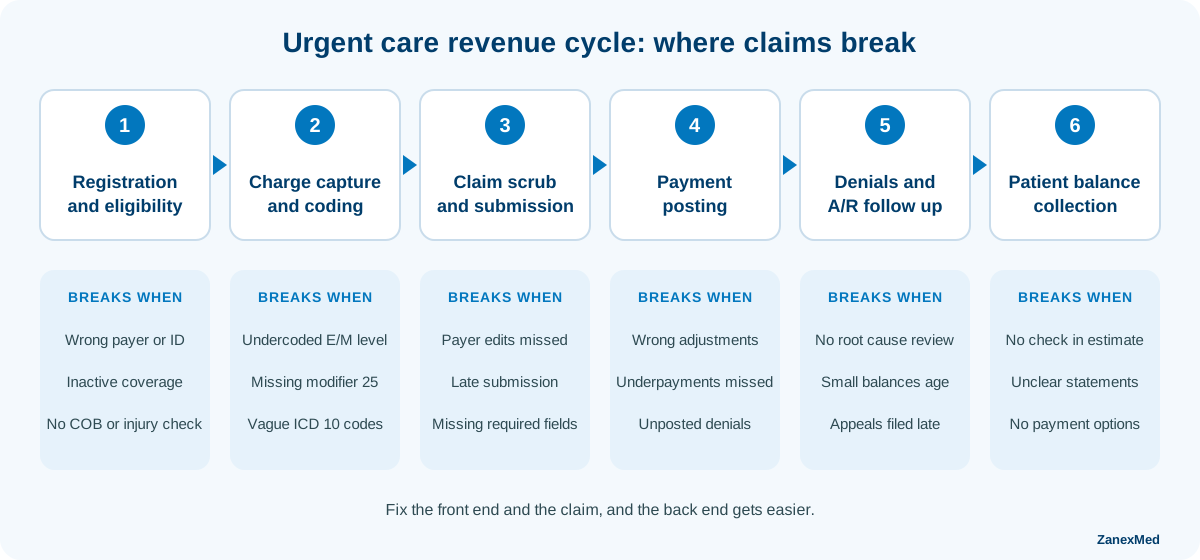
Better urgent care medical billing performance comes from fixing the front end first: capture charges completely, verify eligibility at check in and scrub every claim before it goes out. The diagram below shows the six stages and where claims usually break.
- Standardize charge capture. Use visit templates for common conditions so diagnoses, procedures and supplies are captured before the patient leaves.
- Verify eligibility at check in. Run a real time check and confirm the primary payer, copay and deductible.
- Audit coding every quarter. Compare E/M levels with documentation and look for missed modifiers and unbilled services.
- Scrub claims and submit within 72 hours. Clean claims paid on the first pass cost far less than reworked claims. See medical claim submission services.
- Work denials by root cause. Group denials by reason, payer and provider, then fix the process that created them.
- Collect at the time of service. Quote copays, offer payment options and send clear statements for the rest.
- Review KPIs weekly. Short weekly reviews catch problems before they become month end surprises.
If you want a full audit of the cycle, our revenue cycle optimization services find leaks, fix them and measure the results.
In House vs Outsourced Urgent Care Medical Billing
Outsourcing urgent care medical billing makes sense when denial rates are high, A/R is aging or your team spends more time on rework than on patients. Keeping billing in house can work well when volume is steady and you can hire and retain certified staff.
| Factor | In house billing | Outsourced billing |
|---|---|---|
| Cost structure | Salaries, benefits, software and training | Fee based on collections or a flat monthly rate |
| Coverage | Gaps during leave and turnover | Team coverage all year |
| Coding expertise | Depends on who you hire | Certified coders and audits |
| Reporting | Depends on your software | Standard monthly reports |
| Control | Full direct control | Shared control with clear reporting |
Compare options with a clear quote. Our medical billing pricing page explains how plans are built.
How ZanexMed Helps Urgent Care Centers
ZanexMed delivers urgent care medical billing with a complete team: certified coders, clean claim submission within 72 hours of service, denial management, A/R follow up, patient billing and monthly reporting by payer and location. We also help with out of network negotiation and Independent Dispute Resolution when payers underpay.
We work with providers across the United States, including freestanding emergency rooms and urgent care centers in Texas. Read about the best medical billing services company Texas providers can hire or browse our medical billing services by specialty.
Because every center is different, we start with a free review of your claims, denials and A/R before suggesting any changes. That review shows your current denial rate, days in A/R and the payers that cost you the most, so the plan is built on your own numbers.
Want to see what leakage may be costing your center? Try the free Revenue Leakage Estimator or get a free billing audit from a billing specialist. No obligation and no hidden fees.
Urgent Care Medical Billing FAQs
What are the biggest urgent care medical billing challenges?
The biggest challenges are accurate coding for walk in visits, front desk eligibility errors, claim denials, a mixed payer and self pay patient base, slow A/R follow up and weak reporting. Most can be reduced with clean charge capture, real time eligibility checks, claim scrubbing and denial analytics.
What CPT codes do urgent care centers use most?
Most urgent care visits use new patient E/M codes 99202 to 99205 or established patient codes 99211 to 99215, often with procedure, injection, X ray or lab codes. Use modifier 25 when a separately identifiable E/M is billed with a procedure, and confirm each payer’s rules.
What place of service code is used for urgent care?
Place of service 20 identifies an urgent care facility. Using the correct place of service code matters because it can affect allowed amounts, payer edits and how a claim is priced.
Can urgent care centers bill with S9083?
Some payers accept S9083 as a global urgent care fee that covers the visit, while many require itemized CPT billing. Check each payer contract and fee schedule before choosing how to bill.
Why are urgent care claims denied?
Common reasons include bundling or modifier conflicts, medical necessity, missing information, coordination of benefits issues, inactive coverage and late filing. Front end eligibility checks and claim scrubbing prevent many of them.
What is a good clean claim rate for urgent care?
Many billing teams target a clean claim rate of 95% or higher, meaning claims are accepted on the first submission. Lower rates usually point to registration, coding or scrubbing problems.
How many days in A/R should an urgent care have?
Many urgent care centers aim for fewer than 40 days in A/R. The right target depends on payer mix, so track it by payer and work claims in age buckets.
Should an urgent care outsource medical billing?
Outsourcing makes sense when denial rates are high, A/R is aging or staff turnover leaves gaps in follow up. It gives you certified coders, steady follow up and standard reports without hiring a full team.
How much does urgent care billing cost?
Billing companies usually charge a percentage of collections or a flat monthly fee, and quotes vary with volume and services. ZanexMed gives a custom quote after a free billing review, with clear pricing and no hidden fees.