
The CO 97 denial code means the payer considers the billed service part of the payment for another service that was already paid, so it will not pay for it separately. It is a bundling adjustment. Most CO 97 denials are fixed by checking the NCCI edit for the code pair, adding the right modifier only when the record supports it, or confirming that the service really is included.
This guide explains what the CO 97 denial code means, why it appears, how it differs from CO 45, CO 16 and CO 50, and a seven step process to fix it. You will also find NCCI indicator and modifier tables, real world examples and a prevention checklist.
CO 97 Denial Code at a Glance
- Official meaning: the benefit for this service is included in the payment or allowance for another service that has already been adjudicated.
- Group code: CO, a contractual obligation, so the provider is responsible and the patient usually cannot be billed.
- Type: a bundling denial, usually driven by NCCI procedure to procedure edits or payer policy.
- Common remark codes: M15 (separately billed services were bundled) and M144 (pre and post procedure care is included).
- Best fixes: check the NCCI pair, review the documentation, add modifier 25, 59 or an X modifier when valid, then send a corrected claim or appeal.
- Time limit: follow the payer’s appeal deadline, often 60 to 180 days, and 120 days for a Medicare redetermination.
Table of Contents
What Does the CO 97 Denial Code Mean?
CO 97 is a Claim Adjustment Reason Code (CARC) that tells you the payer bundled the service into another paid service. The official wording says the benefit for this service is included in the payment or allowance for another service or procedure that has already been adjudicated.
The CO part is the group code. It stands for contractual obligation, which means the provider, not the patient, carries the adjusted amount unless the claim is corrected or overturned. You will see the CO 97 denial code on the 835 electronic remittance advice (ERA) or the paper EOB, often with a remittance advice remark code (RARC) that adds detail. The official lists are published by X12 as CARC codes, and Medicare contractors such as Noridian explain how they use it in their bundled services guidance.
Left alone, the CO 97 denial code quietly drains revenue. A single bundled visit may be worth only a small amount, but the same code pair repeated across hundreds of claims a month adds up. It can also expose coding habits that raise audit risk. That is why every CO 97 line deserves a quick decision: fix it, appeal it or accept it.

| Element | What it means |
|---|---|
| CARC | 97 |
| Group code | CO, contractual obligation |
| Meaning | The service is included in another service that was already paid |
| Typical RARC | M15, M144 and others, depending on the payer |
| Who is responsible | The provider, unless the claim is corrected or overturned |
| Usual cause | NCCI edits, global periods or payer bundling policy |
CO 97 vs CO 45, CO 4, CO 16 and CO 50
The CO 97 denial code is about whether a service is separately payable, not about price or missing data. That is what separates it from the other CO codes you see most often.
| Code | Meaning | Main fix |
|---|---|---|
| CO 97 | Service is bundled into another paid service | Check the NCCI pair, modifier and documentation |
| CO 45 | Charge exceeds the contracted or fee schedule amount | Usually a normal write off, but check for underpayment. See the CO 45 guide. |
| CO 4 | Procedure code is inconsistent with the modifier, or a required modifier is missing | Correct the modifier and resubmit |
| CO 16 | Claim lacks information or has a billing error | Correct and resubmit. See the CO 16 guide. |
| CO 50 | Service was not deemed medically necessary | Fix diagnosis and documentation, then appeal. See the CO 50 guide. |
Common Causes of the CO 97 Denial Code
The most common causes of the CO 97 denial code are NCCI procedure to procedure edits, missing or incorrect modifiers, services inside a global surgical package and codes that payers treat as always bundled. Knowing which one applies tells you whether to fix, appeal or write off.
- NCCI PTP edits. Each edit pairs a comprehensive column one code with a component column two code. When both are billed for the same patient, provider and date, the component is denied.
- Missing or wrong modifier. Modifier 25, 59 or an X modifier is absent, or is used without support in the note.
- Global surgical package. A visit or minor service related to a procedure is billed inside its 0, 10 or 90 day global period.
- Always bundled codes. Medicare physician fee schedule status B codes are never paid separately, and payers also bundle routine supplies and some routine venipuncture under their own policies.
- Same day overlap. Two services by the same provider or group on one day overlap in work, such as two evaluations or a procedure and its closure.
- Unbundling. Components of one comprehensive procedure are billed on separate lines.
- Payer specific rules. Commercial plans may bundle pairs that Medicare does not, so the same claim can pay in one plan and deny in another.
Repeated bundling errors are a coding process problem. Our guides to coding audits in medical billing and common medical billing errors show how to find them.
NCCI Edits and Modifier Indicators Explained
NCCI procedure to procedure (PTP) edits are the main source of CO 97 denials, and each edit has a modifier indicator that tells you whether the pair can ever be billed together. CMS publishes the edits and updates them every quarter, so use the current release from the CMS NCCI page.
| Modifier indicator | Meaning | What you can do |
|---|---|---|
| 0 | A modifier is not allowed. The pair never pays together. | Bill only the correct code or remove the component |
| 1 | A modifier is allowed when the record shows a separate service. | Add the right modifier and send a corrected claim |
| 9 | The modifier does not apply because the edit is not in effect. | Nothing to fix under NCCI; check payer policy |
Medically unlikely edits (MUEs) are different. They limit the units of service for a code and usually appear with a different reason code. If the denial is on a line billed more than once, check the unit count as well.
Modifiers That Can Resolve a CO 97 Denial
Modifiers 25, 57, 59, XE, XS, XP, XU, 24 and 79 are the ones most often used to show that a bundled looking service was separate, but a modifier only works when the record supports it. Never add one just to get paid.

| Modifier | Use | Watch out for |
|---|---|---|
| 25 | Significant, separately identifiable E/M on the same day as a procedure | The note needs work beyond the usual pre procedure evaluation |
| 57 | E/M that led to the decision for major surgery | Applies to the day before or day of surgery |
| 59 | Distinct procedural service, such as a different session, site or lesion | Overused. Use an X modifier when one fits. |
| XE, XS, XP, XU | More specific than 59: separate encounter, structure, practitioner or unusual nonoverlapping service | Pick the one that matches the facts |
| 24 | Unrelated E/M during a postoperative period | Document why the problem is unrelated |
| 79 | Unrelated procedure by the same physician during a postoperative period | Use a different diagnosis and document it |
Adding a modifier without support is a compliance risk and can trigger audits. If the note does not show a separate service, leave it off. For a specialty example, see how modifier 25 comes up in urgent care medical billing.
CO 97 Denial Examples and How to Handle Them
Three common situations account for most CO 97 denials: a visit billed with a procedure, a visit inside a global period and two procedures that overlap. Each needs a different response.
Example 1: Visit billed with a procedure
A provider bills a level 4 office visit (99214) and a simple wound repair (12002) on the same day. The payer pays the repair and returns the CO 97 denial code on the visit. If the note shows a separate problem that needed its own evaluation, resubmit 99214 with modifier 25 and attach the note. If the visit only covered the decision to repair the wound, the visit is included and the denial stands.
Example 2: Visit inside a global period
A surgeon bills 99213 on day 10 after a procedure with a 10 day global period. The payer returns CO 97 with M144. If the visit was routine follow up, it should have been reported with 99024 and no charge. If it addressed a new, unrelated problem, resubmit with modifier 24 and a different diagnosis.
Example 3: Overlapping procedures
Two procedures are billed for the same site and session, and one is a column two code in an NCCI pair with modifier indicator 0. No modifier can fix it. Remove the component code or accept the adjustment.
How to Fix a CO 97 Denial in 7 Steps
To fix the CO 97 denial code, read the remittance, check the code pair, review the documentation, choose the right path and then correct, appeal or write it off. The flow below shows the three possible outcomes.
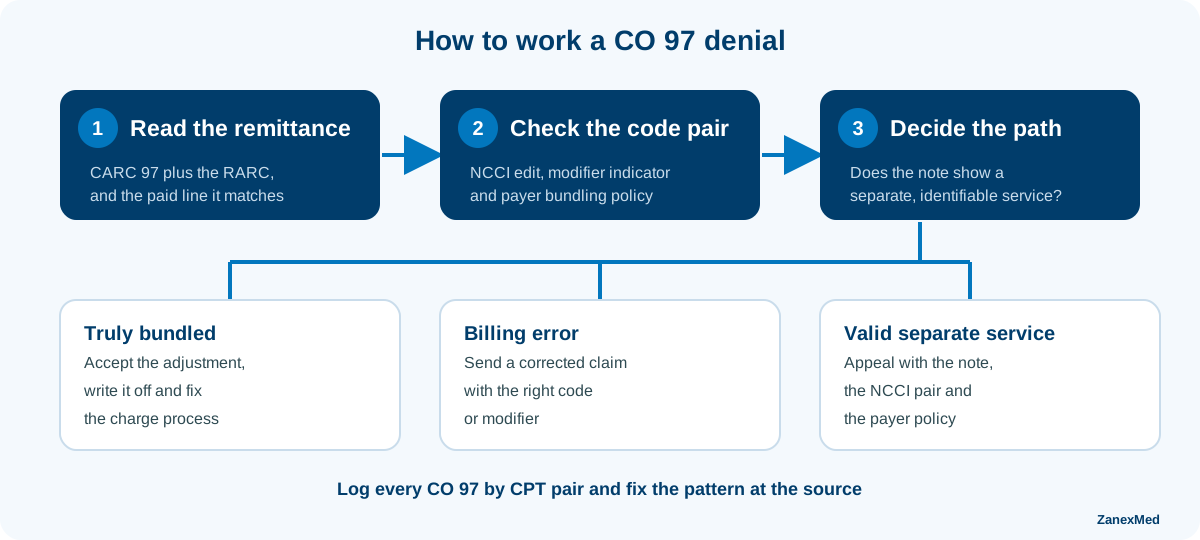
- Read the remittance. Find the CARC 97 line, the RARC and the paid line it was bundled with.
- Look up the code pair. Check the NCCI edit and the payer policy to see which code is column one and two and what the modifier indicator says.
- Review the documentation. Confirm whether the note shows a separate site, session, problem or practitioner.
- Choose the path. The service is truly bundled, the claim has a billing error, or the service was valid and separate.
- Correct and resubmit. For billing errors, send a corrected claim (frequency code 7) with the right code or modifier if the payer allows it.
- Appeal when you have grounds. Send a short letter with the visit note, the NCCI pair and the payer policy before the deadline. Medicare redetermination must be requested within 120 days.
- Post, log and learn. Post the adjustment, record the CPT pair and cause, and share the pattern with coders and providers.
The full workflow, from triage to appeals, is covered in our guide to medical billing denial management, and our denial management services can run it for you.
How to Prevent the CO 97 Denial Code
You prevent the CO 97 denial code by checking NCCI edits and payer bundling rules before the claim goes out, coding from complete documentation and training providers on when modifiers apply. Most bundling denials are visible before submission.
- Run a claim scrubber that loads each quarterly NCCI release.
- Build modifier prompts into charge capture, and require the note to support them.
- Audit your top code pairs every month and fix the ones that keep denying.
- Keep a payer policy library, because commercial plans bundle differently from Medicare.
- Teach providers the global period rules and what a separate service looks like in the note.
- Track the CO 97 rate by payer, provider and code pair, alongside the KPIs in our guide to revenue cycle management KPIs.
Review your CO 97 denial code report every month. Group the lines by CPT pair, payer and provider, then fix the top three. A small change, such as a modifier prompt on the charge capture screen, can cut repeat bundling denials noticeably and gives your coders one clear rule to follow.
Can You Bill the Patient for CO 97?
In most cases you cannot bill the patient for a CO 97 adjustment because it is a contractual obligation of the provider. Sending a statement for a bundled service can breach your payer contract and, for Medicare, program rules.
Exceptions are rare and depend on your contract, state law and whether the patient signed a valid notice for a non covered service. When in doubt, write off the amount and fix the process. Patient responsibility amounts such as deductibles and copays appear under the PR group code, not CO. Our patient billing services help keep statements accurate.
How ZanexMed Helps With CO 97 Denials
ZanexMed’s certified coders review each CO 97 denial code by code pair, correct claims that were billed wrong, file appeals with NCCI and documentation support, and fix the front end causes. Our medical coding services and claim scrubbing keep bundling errors from reaching the payer in the first place.
We work with providers across the United States, including Texas. Read about the best medical billing services company Texas providers can hire, try the free Revenue Leakage Estimator or get a free billing audit. We review your denials by reason and payer, then share a clear plan with no obligation and no hidden fees.
CO 97 Denial Code FAQs
What does the CO 97 denial code mean?
The CO 97 denial code means the benefit for the service is included in the payment or allowance for another service that was already adjudicated. In plain terms, the payer bundled the service and will not pay for it separately.
Is CO 97 a denial or an adjustment?
CO 97 is an adjustment reason code. The line shows no separate payment because the service was bundled, while other lines on the claim may still be paid. It becomes a true denial you must act on when the service was billed wrong or was actually separate.
What is the difference between CO 97 and CO 45?
CO 97 means the service is bundled into another paid service. CO 45 means the charge exceeds the contracted or fee schedule amount, which is usually a normal write off. One is about payability and the other is about price.
Can you appeal a CO 97 denial?
Yes, when the record shows a separate, identifiable service. Send a short appeal with the visit note, the NCCI pair and the payer policy before the deadline. If the service is truly bundled or the NCCI indicator is 0, an appeal will not succeed.
Which modifier fixes CO 97?
No single modifier fixes it. Modifier 25, 59, XE, XS, XP or XU can resolve a bundling denial only when the documentation supports a separate service and the NCCI modifier indicator allows it. Check the indicator first.
What remark codes appear with CO 97?
M15 and M144 are common. M15 says separately billed services were bundled as components of the same procedure, and M144 says pre and post procedure care is included. Payers may use others, so read the full remittance.
Can you bill the patient for CO 97?
Usually no. CO means contractual obligation, so the provider carries the amount. Billing the patient can breach your payer contract and program rules. Check your contract and state law before sending any statement.
How long do you have to appeal CO 97?
It depends on the payer. Many allow 60 to 180 days from the denial date, and Original Medicare allows 120 days from receipt of the initial determination to request a redetermination. Calendar the deadline when the denial arrives.
How do you prevent CO 97 denials?
Use a claim scrubber with current NCCI edits, code from complete documentation, add modifiers only when supported, train providers on global periods and audit your top code pairs every month.